Image Source: Envato
Whole life insurance in Canada can grow tax-advantaged cash value and deliver a tax-free death benefit. For incorporated business owners, it can shelter retained earnings, transfer wealth efficiently, and help balance an estate among heirs without a forced sale of business assets.
Most Canadians think of life insurance as a safety net: something that protects a family if the unexpected happens. Whole life insurance options in Canada can do that too, but for incorporated professionals and business owners with significant assets, permanent life insurance can do more.
When designed properly, a whole life insurance policy can serve as a lasting, reliable part of a broader wealth plan, steadily accumulating cash value in the background while reinforcing tax efficiency, estate planning objectives, and the smooth transfer of wealth to the next generation.
At Longevity Wealth, we view whole life insurance the same way we view every other part of a client's financial picture: as one part of a coordinated whole, not a standalone policy sold in isolation.
Here’s how permanent insurance works as a legacy and wealth tool, and where it fits for incorporated professionals and business owners.
What Makes Whole Life Insurance a Wealth Tool, Not Just Coverage
Whole life insurance is a form of permanent life insurance.
Lifetime Coverage at Average Cost
Unlike term life insurance, which provides life insurance coverage for a set period and then coverage ends at a certain age, a whole life policy stays in force for your entire lifetime as long as premiums are paid.
This is one of the clearest differences between permanent life insurance plans and term policies, and it's the reason whole life shows up so often in long-term wealth conversations.
Builds Cash Value
A whole life insurance policy also builds cash value over time on a tax-advantaged basis, which is what turns it from simple life coverage into a wealth-building strategy. That cash value grows steadily, and you can withdraw money or borrow against it through a policy loan during your lifetime, while the death benefit remains available to your estate or beneficiaries.
Dividend Growth
A large number of whole life insurance policies issued in Canada are participating policies, which means they may qualify for dividends paid from the insurance company's participating account. While these dividends are not guaranteed, when they’re paid out, you can use them to purchase extra coverage, lower upcoming premiums, or take the money as cash.
Over many years, this can significantly lift both the policy’s cash value and its death benefit beyond the guaranteed figures set out in the original contract. It’s another key reason whole life insurance works differently from term insurance: the policy can build value over your lifetime, rather than offering only level, fixed coverage.

Image Source: Gemini 2026
This dual function, lifetime coverage plus a guaranteed payout at death, adds financial security that complements the growth-oriented investments your dedicated advisor is already managing on your behalf.
How Whole Life Insurance Supports Business Owners
Whole life insurance provides incorporated business owners with a tax-sheltered home for retained earnings that would otherwise be fully taxable passive income within the corporation.
Insurance for business owners in Canada offers a few advantages that extend beyond personal estate planning, especially if those retained earnings aren't being actively reinvested in the business.
Corporate-Owned Life Insurance and Tax-Sheltered Growth
Corporate-owned life insurance, often shortened to COLI, allows a corporation to own a whole life insurance policy on the life of an owner or key shareholder. The policy's cash value grows on a tax-sheltered basis within the company, and the death benefit can be paid out to the corporation's beneficiaries, often with significant tax advantages through the capital dividend account.
This means retained earnings that might otherwise be taxed as passive investment income can instead grow as cash value within an insurance policy structure and later be paid to your estate or family as a tax-free benefit. This is a deliberate way to position corporate capital, not a promised rate of return, nor a replacement for sound tax planning.
There is also an important liquidity concern to consider. When a business owner dies, their corporate shares are typically treated as sold at fair market value for tax purposes, which can result in a large capital gains tax bill for the estate.
If no strategy is in place ahead of time, that tax cost may pressure the family to sell key business assets, or even the entire company, simply to raise the cash to pay it. A death benefit paid to the corporation or the estate can supply the funds to settle this tax bill directly, helping the business transfer to the next generation intact.
Other Types of Business Insurance, and Why This Isn't One of Them
Many business owners also carry business insurance to protect against income loss, disability insurance to cover overhead costs if they can't work, and health insurance for themselves and their employees. While important, these policies solve a different problem: keeping the business running day-to-day.
Key person insurance falls into the same category. It protects the company if an owner, partner, or key team member were to pass away unexpectedly, covering lost income and giving the business time to find a replacement. Whole life insurance used for legacy and wealth transfer purposes is focused on you and your family's long-term financial picture, not the operational risk to the business itself.
Many business owners benefit from having both in place, structured separately so each does its job. If you already have or are considering key people coverage, your dedicated advisor can help you map out how the two strategies work together without overlap.
Whole Life Insurance as an Estate and Legacy Planning Tool
Whole life insurance can pass wealth to the people you care about efficiently, often outside of probate and free of tax. For many of our clients, that outcome matters more than the tax or corporate mechanics behind it.
Tax-Efficient Wealth Transfer
When structured properly, the death benefit from a whole life policy passes to your named beneficiaries outside of your estate, which means it can bypass probate and the associated delays and fees. It also generally passes as a tax-free payment to the beneficiary, making it one of the most efficient life insurance products for transferring wealth to the next generation.
This matters most when your life insurance needs go beyond simple protection. Illiquid estates, private companies, real estate, or portfolios that aren't easily divided often need immediate cash on hand to cover final, funeral, and end-of-life expenses, or outstanding loans.
A death benefit provides that liquidity while the rest of the estate is settled.
Equalizing an Estate Among Heirs
Whole life insurance is also a useful tool when your assets are not easily split evenly. If one child is taking over the family business and another is not, for example, a life insurance policy can be used to provide the second child with an equivalent inheritance without forcing a sale or division of the business itself.
This kind of estate equalization strategy comes up frequently in our conversations with incorporated professionals and serial entrepreneurs who want fairness among their heirs without disrupting the business they’ve spent years building.
Life insurance plans built with flexible coverage options can be structured to fit almost any family situation. It’s a natural extension of the broader estate strategy conversation, and it pairs closely with the planning we cover in our guide to estate planning for business owners.
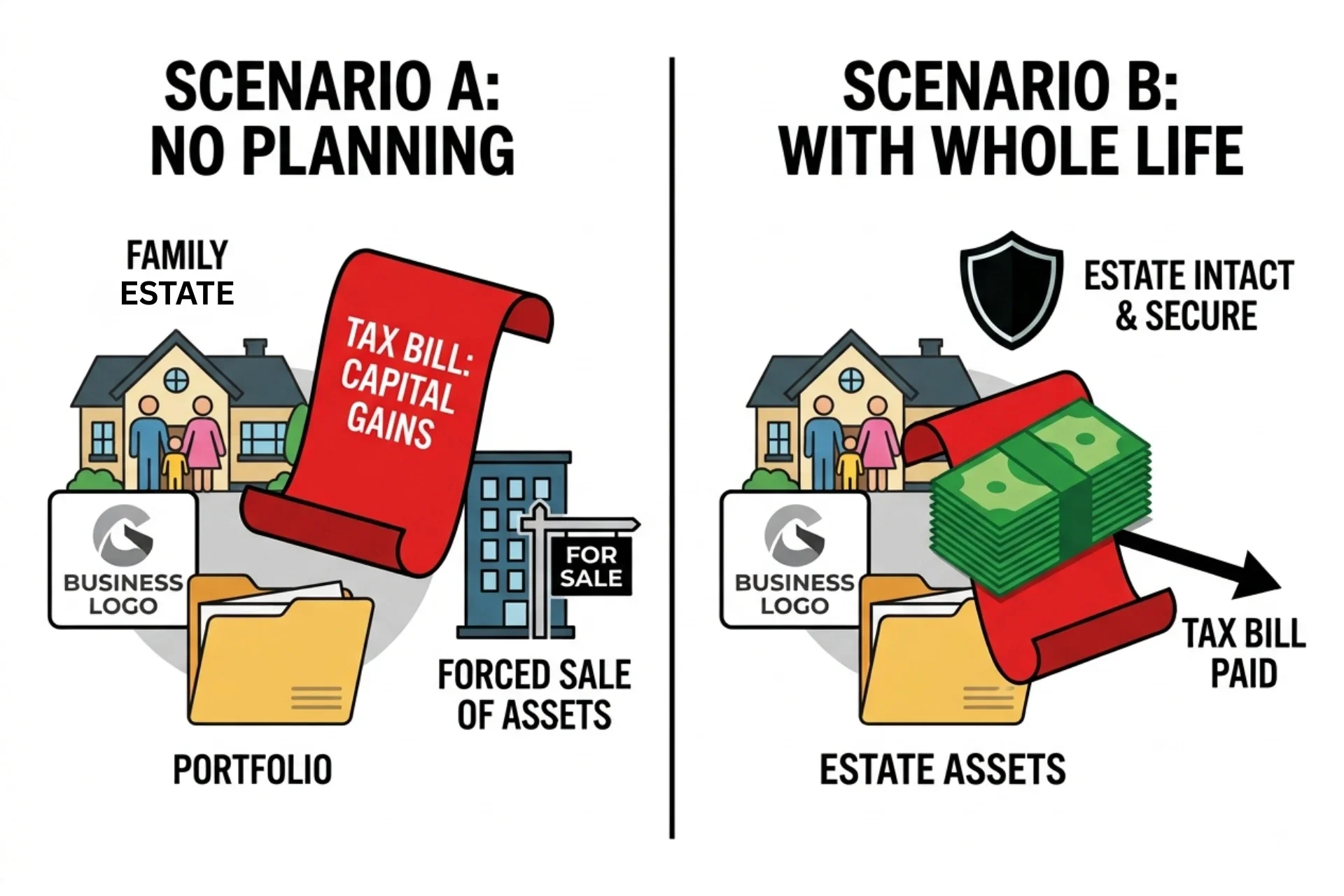
Image Source: Gemini 2026
Is Whole Life Insurance Right for You?
Whole life insurance is not the right fit for everyone, and it’s not meant to replace other insurance policies or forms of wealth planning. It tends to make sense for people who:
Have already maximized their registered savings
Have retained earnings in a corporation they’re not actively using
Have specific estate goals around liquidity, tax efficiency, or fairness among heirs.
Whole life policies require higher premiums than term insurance, reflecting the lifelong protection and cash value component built into the plan; insurers factor in details like your age, health, and smoking status when setting that premium.
The cash value also grows slowly in the early years, so this is a long-term commitment rather than a quick decision based on an online quote. The right coverage depends on your income structure, your corporate situation, and what you’re actually trying to accomplish for your family or your business.
A whole life insurance policy also isn't a decision you make once and forget. As your corporation grows, as retained earnings build, or as your estate plan shifts to reflect a new marriage, a growing family, or a change in who's taking over the business, your coverage amount and structure should be revisited, too. What made sense five years ago may not reflect your life insurance needs today.
That's a conversation, not a checklist, and it's one best to have with an advisor who can see your full financial picture rather than just the insurance coverage on its own.
FAQs About Permanent Life Insurance
-
Whole life insurance is not a traditional investment. It offers tax-advantaged cash-value growth and a guaranteed death benefit, making it a useful complement to other wealth-planning strategies.
-
Corporate-owned life insurance may help protect retained earnings from ongoing tax and can enable tax-efficient distributions through the capital dividend account. Please confirm the details with your advisor and accountant.
-
Whole life insurance used for legacy planning is designed to support the transfer of personal and family wealth. Key person insurance, by contrast, safeguards the company against the financial loss resulting from an owner's death.
-
It provides tax-efficient, probate-free funds to beneficiaries, which can cover final expenses, equalize an estate among heirs, or add liquidity when other assets are difficult to divide.
Key Takeaways
A permanent (whole life) insurance policy accumulates cash value on a tax-advantaged basis for your entire lifetime, whereas term life coverage lasts only for a defined period and then expires.
With corporate-owned life insurance, business owners can build retained earnings within a tax-sheltered policy instead of having them taxed as passive investment income.
The death benefit from permanent life insurance is typically paid to beneficiaries tax-free and bypasses probate, providing an estate with quick, adaptable liquidity when it is needed most.
Whole life insurance can help balance inheritances, so one child receives the business while another receives a comparable cash benefit.
Build a Legacy That Lives Well, Longer
Whole life insurance in Canada is more than a simple box to tick. When set up with care, it can serve as a key piece of an integrated plan that ties together your tax strategy, your estate objectives, and the long-term legacy you intend to create.
For incorporated professionals and business owners, this means evaluating whole life insurance in step with your corporate setup, investments, and overall estate plan, rather than as a standalone decision.
This is the kind of joined-up, big-picture planning that shapes how we work at Longevity Wealth. Your dedicated advisor collaborates with our tax, insurance, and estate experts in one place, so choices like this are made with the full context in mind, not viewed through the lens of a single product.
If you’re wondering whether whole life insurance in Canada belongs in your wealth strategy, book a no-obligation discovery call with our team. We’ll help you understand your options and how they fit into a plan built to help you live well, longer.