
Pension Strategies for Incorporated Owners (IPP and RCA)

Image Source: Canva
Incorporated business owners often have significant wealth trapped inside their corporation once RRSP contribution limits are reached. An individual pension plan and a retirement compensation arrangement let owners extract that wealth tax deductible, building secure retirement income beyond standard limits.
Most incorporated business owners in Canada eventually run into the same wall: the Registered Retirement Savings Plan (RRSP) was designed for employees, not for owners of the companies they work for. Once your salary and retained earnings climb past a certain point, the contribution room starts to feel almost beside the point.
That’s where an alternative retirement plan built specifically for incorporated professionals starts to make sense. Two structures in particular, the individual pension plan and the retirement compensation arrangement, exist to solve the exact problem incorporated owners face: significant wealth trapped inside a private corporation, with limited tax-deductible ways to move it into personal hands over time.
This Longevity Wealth post walks through what an individual pension plan (IPP) and a retirement compensation arrangement (RCA) actually do, who they suit, how the numbers work today, and how a coordinated pension strategy fits into the broader picture of tax planning incorporated professionals rely on as their businesses mature.
It also speaks to the whole picture, because a retirement plan is never just about the account balance. It’s about the life and the people it’s meant to support.
Why RRSPs Stop Being Enough
An RRSP is a useful tool, but it was designed with a fairly generic income profile in mind. Contribution limits are capped as a percentage of earned income, and for owners drawing significant salary or managing retained earnings inside a corporation, that cap becomes restrictive quickly.
The Dual Identity Problem
Incorporating a business creates a distinct legal and tax entity. You become both the shareholder, who owns the company, and often an employee of that same company. This dual identity is powerful for liability protection and tax deferral, but it also means your personal retirement savings and your corporate income are never fully separate.
Wealth generated by the business does not automatically become personal income. It has to be extracted, and the method of extraction, salary, dividends, or a structured pension plan, determines how much of it survives taxes on the way out.
Where a Registered Pension Plan Fits
A registered pension plan is the umbrella category under which IPPs fall.
Unlike an RRSP, a registered pension plan is sponsored by an employer, in this case, your own corporation, and it comes with its own funding formula, actuarial requirements, and tax treatment.
For an incorporated owner, that employer sponsorship is the mechanism that unlocks contribution room well beyond what an RRSP allows, and it’s a common question we hear: what’s the actual difference between a registered pension plan and an RRSP?
The short answer is who funds it, how it’s regulated, and how much can go in each year.

Source: Canva
The Individual Pension Plan: A Corporate-Funded Retirement Structure
An individual pension plan is a defined benefit pension plan sponsored by your corporation, designed for a single, high-income employee, typically the owner. Because it’s a defined benefit rather than defined contribution, it promises specific pension benefits based on your age, salary history, and years of service, and the corporation is responsible for funding that promise on an ongoing basis.
Who Is an IPP For?
An IPP tends to suit incorporated professionals over 40 or 45 who have been drawing a T4 salary from their corporation for several years and want to accelerate retirement savings beyond RRSP limits.
Doctors, lawyers, dentists, and accountants operating through a professional corporation are common candidates, as are business owners with a stable salary history who are ready to build a more robust plan.
Strong candidates typically have several years of consistent salary income and a corporation with reliable cash flow, since the plan requires steady funding over time. One important eligibility note: members cannot participate in another defined benefit pension plan at the same time, so this is a choice that requires ruling out other options first.
Understanding Your IPP Pension Benefits
The contribution limits scale with age, which is part of what makes the IPP attractive for owners who started saving later. In 2025, a 50-year-old can contribute up to $42,900 to an IPP, while a 60-year-old can contribute as much as $53,320. The 2025 defined benefit limit is $3,756.67 per year of credited service, which serves as the benchmark for the IPPs.
Setting up an IPP typically takes a couple of months from the time an actuary prepares a proposal based on your age and salary history. Initial setup costs vary, with annual filing costs of approximately $250 after that.
An actuarial valuation is required every three years to confirm the plan remains properly funded, and this ongoing oversight is exactly why a private pension administrator plays such a central role.
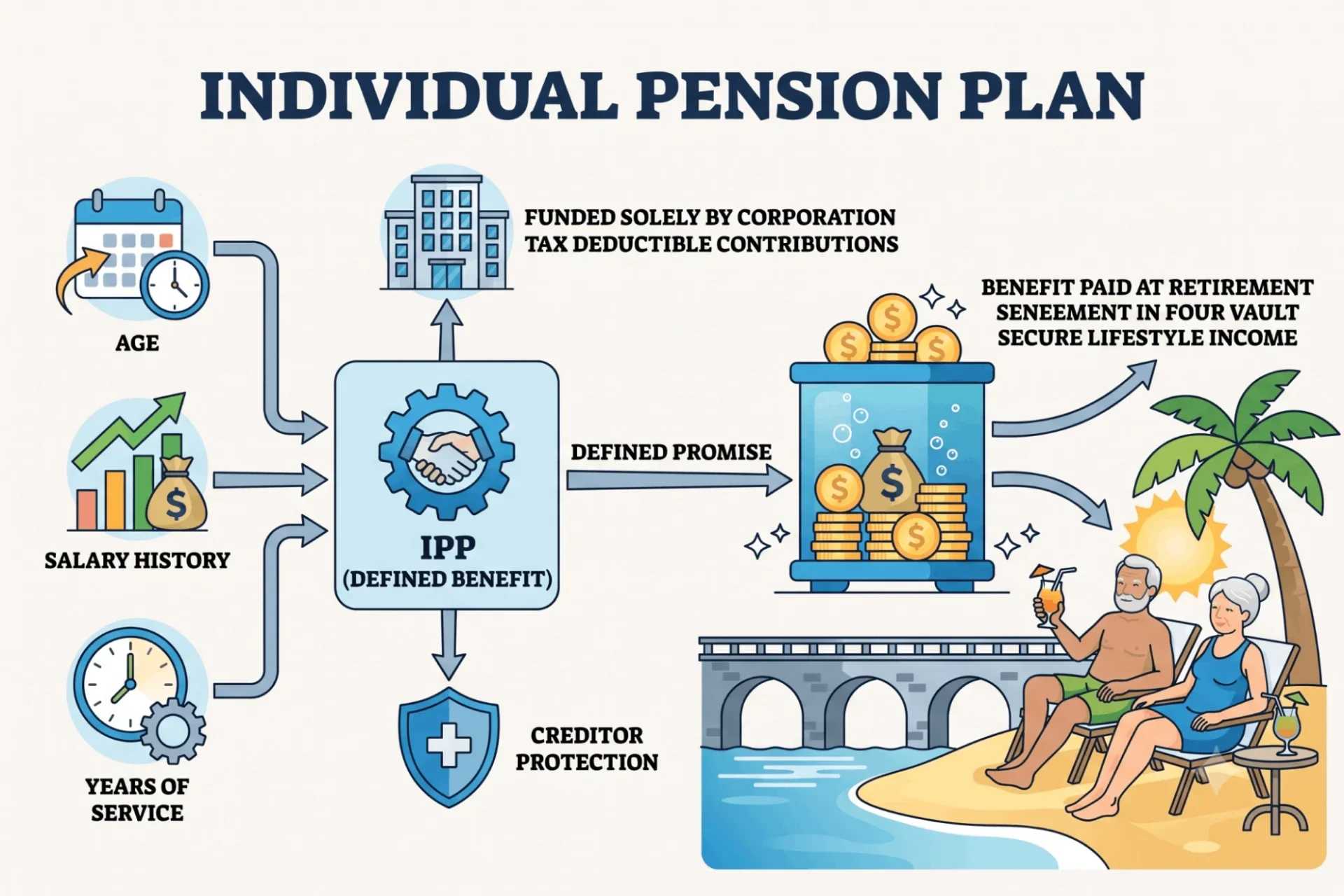
Image Source: Gemini 2026
The Tax Mechanics
Contributions to an IPP are made by the corporation and are generally tax-deductible to the business, similar in spirit to an RRSP deduction but often allowing for materially higher amounts.
Those contributions grow inside the plan on a tax-deferred basis, and funds generally can’t be withdrawn until retirement without triggering tax consequences, which is a common question for individuals weighing an IPP against more flexible savings options.
There’s also a notable protection feature. Assets held inside a registered pension plan, like an IPP, typically enjoy stronger creditor protection than an RRSP, which matters to owners in litigation-exposed professions who want their future secure regardless of what happens on the business side.
An IPP does require ongoing funding and administration, which is precisely why it tends to suit owners with the scale of income and retained earnings to justify the added complexity. It’s a more involved structure than an RRSP, but for the right candidate, the tradeoff is well worth it.
The Retirement Compensation Arrangement: Built for What Comes After the Limits
A retirement compensation arrangement is a separate category of alternative retirement plan, and it solves a different problem than the IPP. Where an IPP works within the Canada Revenue Agency (CRA) pension funding formulas, an RCA is often used specifically because it’s not subject to the same contribution ceilings that apply to registered pension plans and RRSPs.
How an RCA Works
An RCA is funded by the corporation, with contributions held in a refundable tax account and a separate custodial investment account. Half of every contribution goes to the refundable tax account, held with the Canada Revenue Agency, and the other half goes into investments managed on the owner's behalf, often through licensed portfolio management partners such as Bold Wealth and Proof Capital.
On withdrawal, generally at retirement, the refundable tax is returned proportionally, which means the structure is designed to eventually deliver both the invested growth and the recovered tax.
This total return, plus the tax recovery, is part of what makes an RCA appealing once an IPP alone is not enough to meet a high-income earner's retirement plan.
Who Is RCA For?
An RCA is often layered on top of an IPP for owners whose income and retained earnings are high enough that even enhanced IPP limits leave meaningful value trapped inside the corporation.
It also appeals to serial tech entrepreneurs and business owners managing a liquidity event, where a large amount of corporate value needs a tax-efficient, long-term home outside the operating company's immediate reach.
Because an RCA is a more specialized vehicle, it also benefits from coordination with a private pension administrator and legal advice to ensure the arrangement is structured correctly from the outset, including how it’ll eventually terminate or pay out to the member and, where relevant, a surviving spouse.
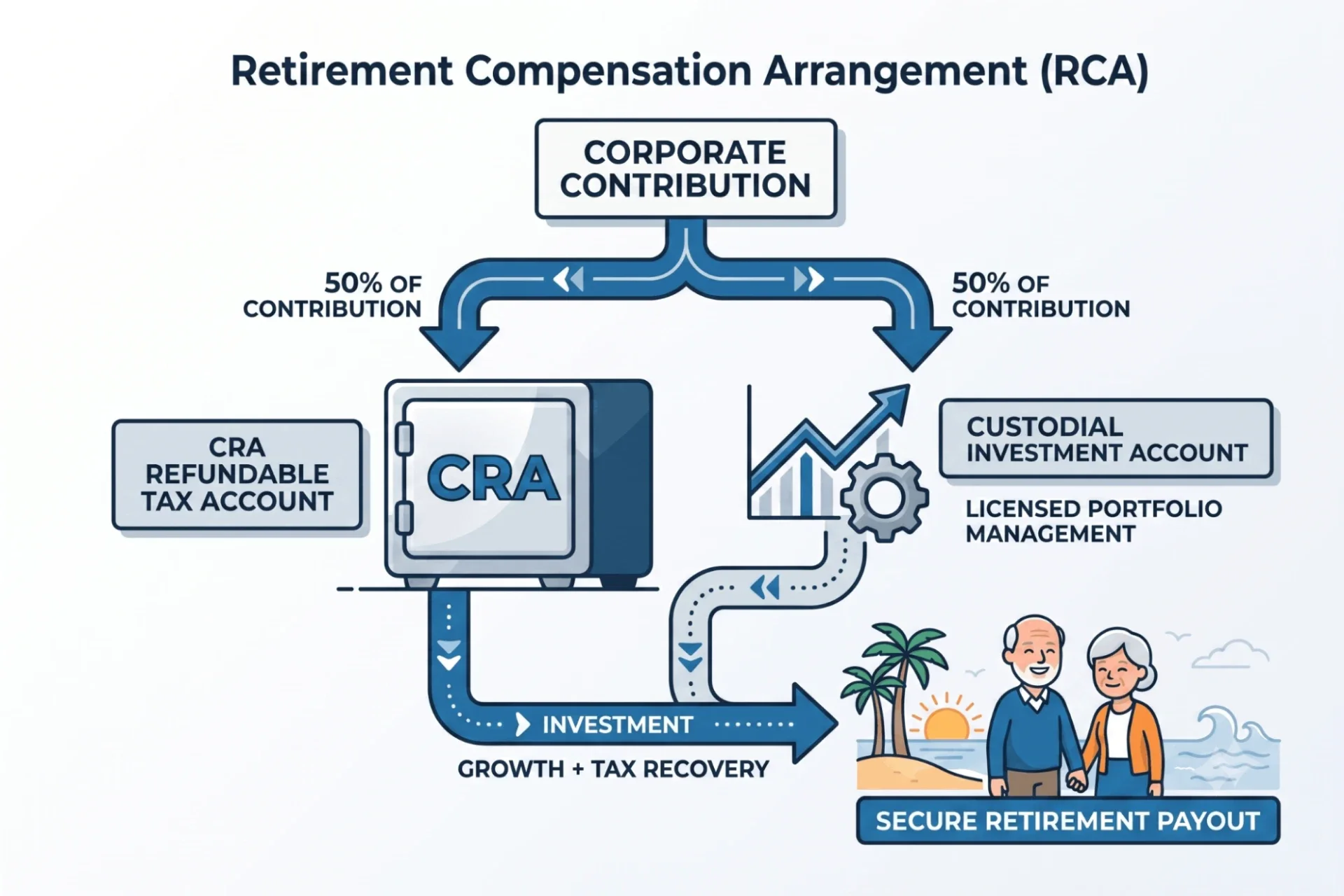
Image Source: Gemini 2026
Building a Coordinated Pension Strategy
Neither an IPP nor an RCA operates in isolation.
The right plan, or combination of plans, depends on your age, your history of salary versus dividend income, the retained earnings sitting inside your corporation, and your broader estate and business succession goals.
It also depends on what kind of life you want this income to support, not just the size of the account you leave behind.
Questions Worth Asking Before You Commit
Before establishing either structure, it’s worth working through a few questions with your advisor:
How much retained earnings does the corporation currently hold, and how much of that is realistically needed for reinvestment versus available for extraction?
Has your salary history been consistent enough to support a meaningful IPP contribution room?
Does your risk profile, liability exposure, or succession timeline point toward one plan over the other, or both together?
These are not questions with generic answers, and they aren’t something to log and revisit once a year. They depend on the specific shape of your business, your income history, and your long-term goals, which is exactly why individuals in this position benefit from advice built around the full picture rather than a single product recommendation.
FAQs About Tax Deductible Retirement Savings
-
An individual pension plan is a corporate-sponsored defined benefit plan with higher contribution limits than an RRSP. The corporation funds and deducts contributions, and the plan requires an actuarial valuation every three years.
-
A private pension administrator manages the ongoing compliance, funding calculations, and reporting required for a registered pension plan like an IPP, working alongside the sponsoring corporation and its actuary to keep the plan properly funded.
-
Generally, no. Funds inside an individual pension plan are locked in until retirement, since the plan is registered and designed to fund a specific pension benefit rather than provide flexible access to savings.
-
A retirement compensation arrangement is an alternative retirement plan funded by a corporation, with half of each contribution held in a refundable tax account and the other half invested. It’s used once IPP and RRSP limits are reached.
Key Takeaways
An individual pension plan lets incorporated owners save beyond RRSP contribution limits
IPP contributions are tax-deductible to the corporation and grow tax-deferred
A retirement compensation arrangement layers on top of an IPP for owners hitting even higher limits
Both structures require a private pension administrator for setup and ongoing compliance
IPP assets carry stronger creditor protection than a registered retirement savings plan
Contribution room increases with age, rewarding owners who start planning earlier
Turning Trapped Corporate Wealth Into a Real Retirement Plan
An individual pension plan and a retirement compensation arrangement are not RRSP alternatives in a generic sense. They’re purpose-built responses to the specific financial identity of an incorporated owner, someone whose wealth lives inside a corporation and needs a deliberate, tax-aware path to personal income.
Getting that path right takes more than choosing a vehicle off a list. It takes coordination among your tax strategy, insurance planning, investment management, and estate goals, all working from the same information rather than operating in silos. That kind of coordination is what turns a good plan into a strategy that fits the life you’re building toward.
That’s the model Longevity Wealth was built around. Rather than acting as a single product provider, your dedicated advisor works alongside tax, insurance, and portfolio management specialists, including our licensed partners Bold Wealth and Proof Capital, to build a wealth strategy that reflects the full complexity of owning an incorporated business.
If trapped corporate wealth has been sitting on your list of problems, a no-obligation consultation is a reasonable place to speak with someone who can help you view the whole picture, not just one account or individual pension plan at a time.
