
Critical Illness Insurance in Canada: A Complete Guide

Image Source: Pexels
Critical illness insurance pays a tax-free lump sum, typically $25,000 to $2 million, if you're diagnosed with cancer, heart attack, stroke, or another covered condition. It replaces lost income during recovery, protecting incorporated business owners where salary-based coverage falls short.
A serious diagnosis changes everything except your bills.
While you focus on recovery, everyday expenses, mortgage payments, and payroll obligations continue to accumulate, significantly increasing the financial pressure on incorporated business owners.
This guide provides a clear breakdown of how critical illness insurance operates, what it covers, and why it’s vital when your personal income is tied to a business you built.
What Is Critical Illness Insurance?
Critical illness insurance, often shortened to CI insurance, pays a lump sum benefit if you’re diagnosed with a covered condition, such as cancer, a heart attack, or a stroke. Unlike disability insurance, which replaces a portion of lost income over time, a critical illness insurance policy delivers one tax-free lump sum payment you can use however you choose.
That flexibility is the point of most critical illness insurance products. There are no restrictions on how the money is spent.
Some people use it to cover medical expenses not included in provincial health insurance. Others use it to pay medical bills, hire temporary staff, or simply build a financial cushion while they focus on recovery rather than financial stress.
What Does CI Stand for in Insurance?
CI is simply shorthand for critical illness. When you see "CI insurance" or "CI coverage" referenced by an insurance company or broker, they’re referring to the same critical illness insurance plan described throughout this guide.
How Does Critical Illness Insurance Work?
Following a covered critical illness diagnosis, the insured individual files a claim accompanied by the necessary medical documentation. Most insurance plans include a survival period, typically ranging from 0 to 90 days, depending on the carrier; the policyholder must survive this period after the diagnosis before the benefit is paid.
Once approved, the insurance company issues a lump sum payout directly to the policyholder. There are no receipts required and no restrictions on use, which sets this living benefit apart from other insurance types.
How Does CI Insurance Differ From Life Insurance?
Life insurance pays a death benefit to protect your family or business after you’re gone. Critical illness insurance protects your finances while you’re still here, but unable to work or run your business at full capacity.
Many Canadians pair the two. Life and critical illness insurance together create a more complete financial safety net, one that addresses both the risk of premature death and the risk of surviving a serious illness with reduced earning capacity.
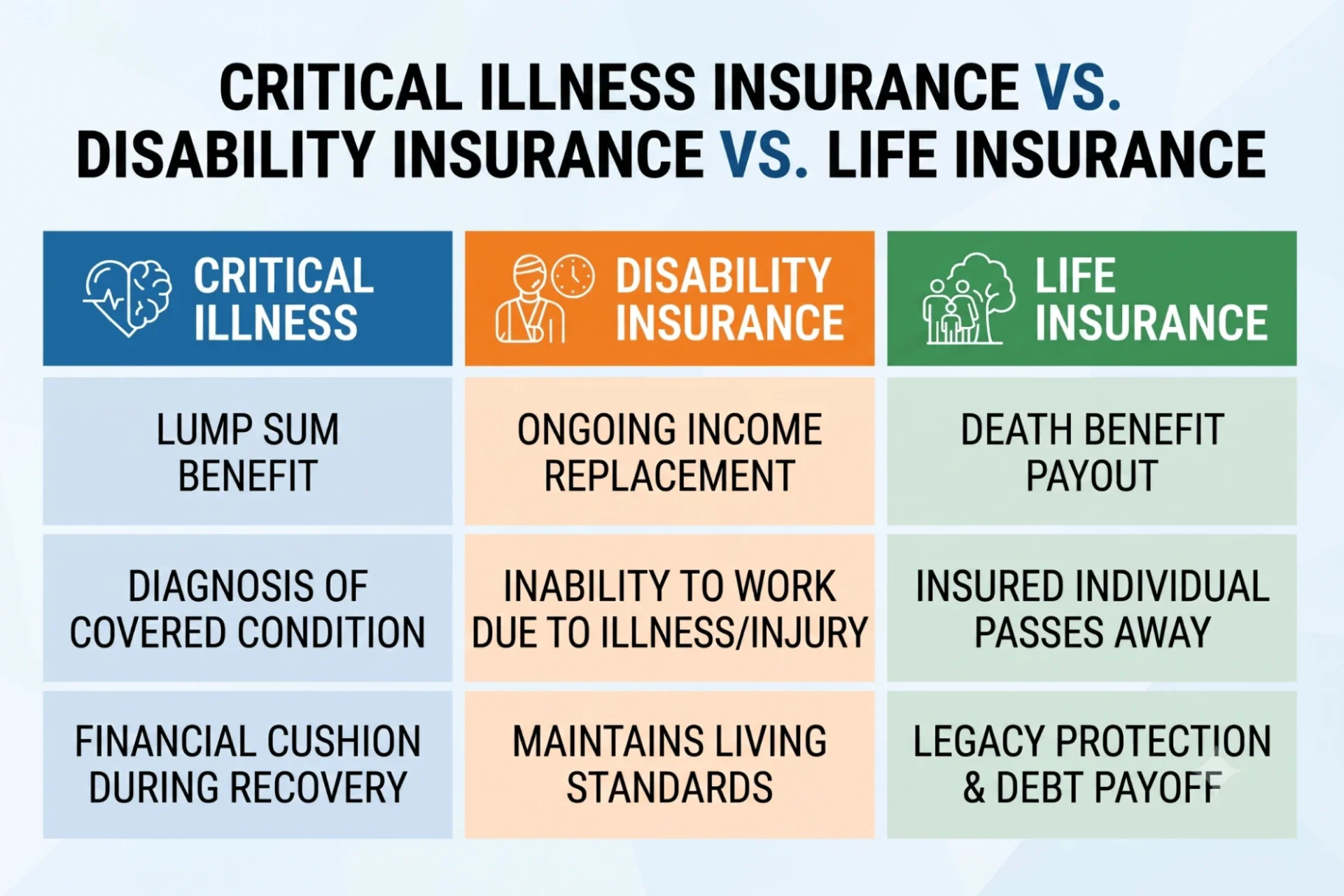
Image Source: Gemini 2026
What Does Critical Illness Insurance Cover in Canada?
In Canada, most critical illness policies cover 20 to 25 conditions, led by cancer, heart attack, and stroke, though the exact list varies by provider and tier. The most frequently covered illnesses include:
Stroke
Heart attack
Life-threatening cancer
Kidney failure
Aortic surgery
Major organ transplant
Coronary artery bypass surgery
Certain plans also cover conditions such as paralysis, Alzheimer's, and multiple sclerosis. Reviewing the specific definitions and exclusions in a critical illness insurance policy matters more than the headline number of conditions, since two policies with the same condition count can define a qualifying diagnosis very differently.
Conditions Typically Excluded
Critical illness insurance plans typically exclude chronic, non-acute conditions. This includes diabetes since it’s a manageable chronic condition rather than a sudden critical event.
The same applies to pancreatitis and fibromyalgia, both of which are excluded under most standard critical illness policies because they don’t fit the acute, diagnosable criteria insurers use to define a covered critical illness.
Pre-existing conditions disclosed at the time of application may also affect eligibility or pricing, which is why a medical exam and full medical history disclosure are typically required.
Why Critical Illness Coverage Matters More for Incorporated Business Owners
If you’re an employee, a serious diagnosis is disruptive. If you’re an incorporated business owner, it can threaten the business itself.
The Income Gap Problem
Many incorporated professionals pay themselves conservatively, drawing a modest annual income while retaining earnings inside the corporation for tax efficiency. That structure works well for growth and tax planning, but it creates a gap during a health crisis.
Your personal income may not reflect what your business actually generates, which means disability coverage calculated on salary alone can fall short of the financial support you actually need.
A lump sum benefit fills that gap. It’s not tied to your salary structure, so it can reflect the real financial impact of stepping away from a business that depends on your active involvement.
Protecting Business Continuity
An untimely illness can disrupt years of hard work for a serial tech entrepreneur navigating a liquidity event or a business owner in the middle of a major contract. Critical illness insurance addresses this by funding a temporary replacement, covering fixed overhead, or providing the necessary time to transition responsibilities without resorting to a fire sale of assets.
This is where critical illness insurance stops being a personal protection product and becomes a business continuity tool, one piece of a coordinated wealth strategy that also includes tax planning, estate planning, and investment management.

Image Source: Canva
How Much Critical Illness Insurance Coverage Do You Need?
There’s no universal number, but a useful starting point is to calculate your financial obligations over a realistic recovery window. A common rule of thumb is to cover at least six months of expenses, though many advisors recommend planning for an extended period, given that recovery timelines vary by condition.
Factors That Influence Coverage Amount
Consider the following when estimating how much coverage you need:
Outstanding debt, including mortgage payments and business loans
Fixed monthly premiums and other financial obligations, both personal and corporate
The cost of hiring temporary help for your role
Existing coverage or liquid retirement savings you could draw on instead
Any group critical illness coverage already provided through an employer or professional association
Individual and business-critical illness insurance policies in the Canadian market often provide coverage ranging from $25,000 to $2 million, depending on the insurer. This gives significant flexibility to match coverage to your actual financial exposure.
Incorporated professionals and business owners often need more coverage than employees with similar annual income, precisely because their income structure doesn’t tell the full story of what a health crisis would cost them.
How Canadian Providers Compare
Coverage options and pricing vary meaningfully across major Canadian insurers. A few examples illustrate the range:
| Provider: | Coverage Range: | Notable Detail: |
|---|---|---|
| RBC Insurance | $25,000 to $2 million | Wide flexibility for high coverage needs |
| Sun Life | Varies by product | Offers two distinct critical illness insurance products |
| Blue Cross Life | Varies by product | Covers 44 conditions, above the industry average |
| TD Insurance | $10,000 to $100,000 | Lower coverage ceiling, suited to smaller supplemental needs |
This kind of comparison shows why a licensed insurance advisor matters. The right policy depends on your specific financial obligations, not just the lowest monthly payment.
When Should You Apply for Critical Illness Insurance?
Timing affects both eligibility and cost. Applying earlier, while you’re young and healthy, generally results in lower premiums and fewer exclusions.
Signs It’s Time to Apply
A few common triggers prompt people to evaluate critical illness insurance:
A family member has a relevant medical history, since family medical history can influence both pricing and future insurability
A major life event, such as starting a business, taking on a mortgage, or having a child
A gap was identified after reviewing existing coverage through an employer
A shift in income structure, particularly for newly incorporated professionals
Before applying, it’s worth evaluating your full financial picture, including existing insurance policies, retirement income planning, and any disability coverage already in place, so your critical illness insurance plan complements rather than duplicates what you already have.
Is Critical Illness Insurance Worth It?
For most people with financial obligations tied to their income, yes, particularly if a serious diagnosis would create a gap that savings or disability coverage alone wouldn't cover. The honest answer still depends on your financial obligations and risk tolerance.
The Case For It
The core value of critical illness insurance is financial protection during a period when your ability to earn is compromised, but your bills are not.
A tax-free lump sum arriving shortly after diagnosis provides immediate financial support when cash flow matters most.
The Disadvantages of Critical Illness Insurance
No product is without drawbacks. Monthly premiums add up over time, and if you never make a claim, you receive nothing back under a standard term policy.
Definitions of covered conditions can be strict, and a diagnosis that feels severe to you may not meet the insurer's specific criteria. Survival period requirements can also delay payout timing during an already difficult stretch.
These tradeoffs don’t make critical illness insurance a poor choice. They make it a product that deserves a proper needs analysis rather than a reflexive purchase.
Choosing the Right Policy
Not all critical illness insurance policies are created equal, and the cheapest option is rarely the most complete one.
Questions Worth Asking Before You Buy
Before selecting a critical illness policy, it’s worth clarifying:
How does the policy define each covered condition, and what triggers a payout?
What is the survival period, and how does it compare across the insurance policies you are considering?
Does the policy offer partial payouts for less severe versions of covered conditions?
Can the policy convert to permanent coverage later if your needs change?
Are there exclusions specific to pre-existing conditions or family medical history?
These details matter more than the sticker price, and they’re exactly the kind of complexity a generic online quote tool will not walk you through.
Building Critical Illness Coverage Into a Bigger Financial Picture
Critical illness insurance rarely works well on its own. It’s most effective when coordinated with your tax strategy, estate plan, and investment approach, rather than being purchased as a one-off product from the advisor handling your mortgage renewal.
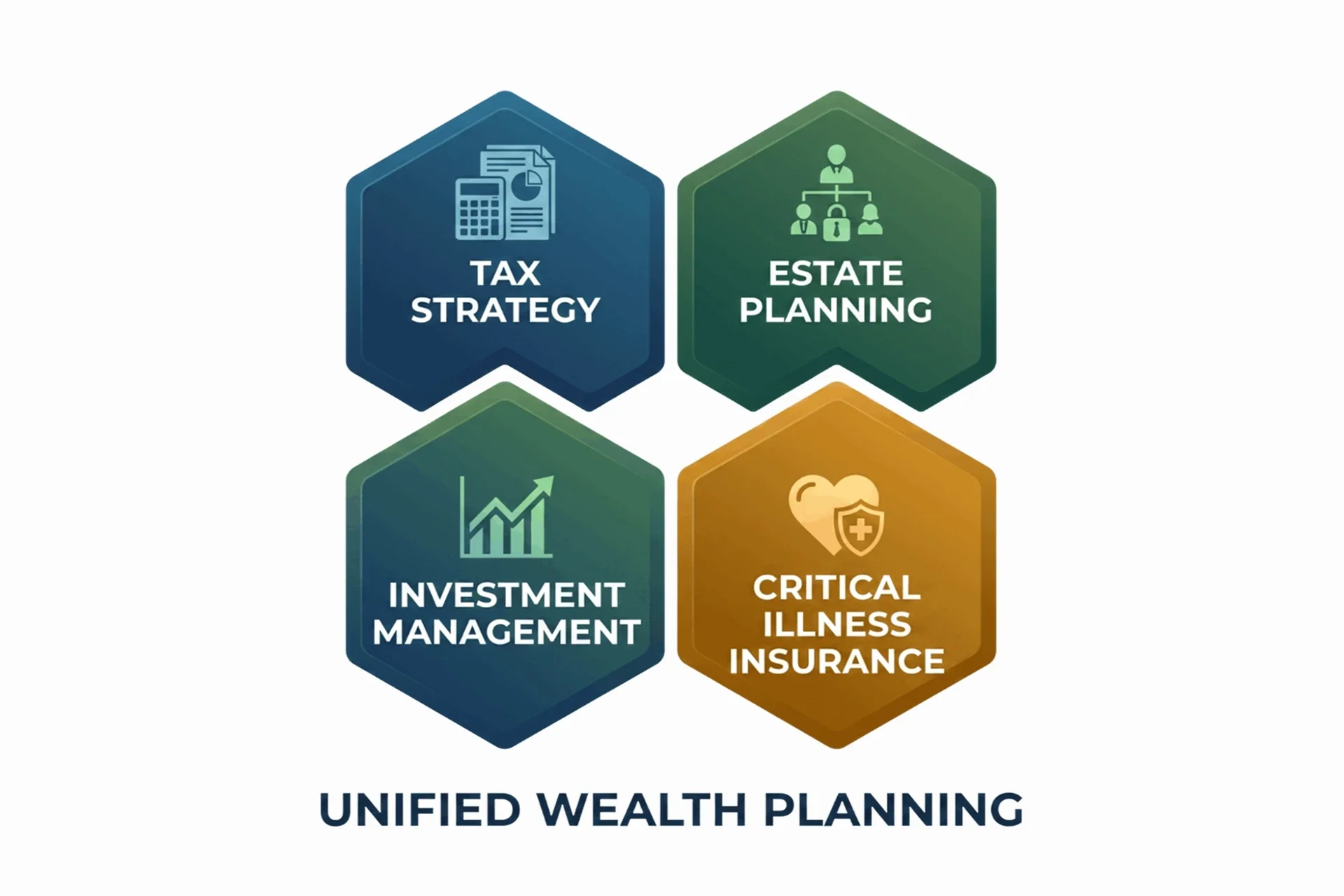
Image Source: Gemini 2026
This is the gap many incorporated business owners and C-suite professionals run into at traditional institutions. You end up as the middleman, relaying information between your accountant, your insurance broker, and your bank's financial planner, none of whose systems talk to each other.
Decisions are made in silos, and insurance coverage is often treated as an afterthought rather than a deliberate part of the plan.
FAQs About Critical Illness Insurance Plans
-
Yes, especially for most people with financial obligations tied to their income. It provides a tax-free lump sum when disability coverage alone may not reflect true financial exposure, especially for incorporated business owners.
-
No. Diabetes is a manageable chronic condition, not an acute critical illness, so it's excluded from most standard critical illness insurance policies in Canada.
-
CI insurance is shorthand for critical illness insurance. It pays a lump sum benefit if you're diagnosed with a covered condition like cancer, heart attack, or stroke.
-
Premiums accumulate with no refund if you never claim under a standard term policy. Strict definitions of conditions and survival periods can also delay or limit payouts.
Key Takeaways
Critical illness insurance pays a tax-free lump sum ($25,000 to $2 million) upon a covered diagnosis.
It differs from disability insurance by providing a single payout instead of ongoing income replacement.
Incorporated business owners often require higher coverage because salary alone understates financial exposure.
Policies focus on acute, diagnosable illnesses, excluding chronic conditions like diabetes, pancreatitis, and fibromyalgia.
Survival periods of zero to 90 days determine when a claim pays out.
Combining life and critical illness insurance provides comprehensive financial protection against death and serious illness.
Live Well, Longer, With a Plan Built Around You
Critical illness insurance is a financial buffer, not just a policy. It gives you room to focus on recovery instead of cash flow when it matters most.
Still weighing whether coverage makes sense? That’s the right stage to ask questions, not commit to anything. At Longevity Wealth, we help you think through where critical illness insurance fits into your broader financial picture, not just your budget for premiums.
We bring insurance planning together with tax strategy, investing, and estate planning into a single coordinated advisory model, delivered by a dedicated advisor matched to your specific situation. That’s the difference between owning a policy and having an actual strategy.
See where you currently stand and book a no-obligation discovery call. No pressure to decide anything today.
