What Private Wealth Management Delivers

Image Source: Gemini 2026
Private wealth management brings tax, portfolio, and estate planning together within one team, giving affluent clients a straightforward, aligned strategy for their wealth. Comparing wealth management firms in Toronto often requires sorting through separate, unconnected guidance on tax planning, investing, and insurance.
Private wealth management means something different to everyone who searches the term. To a big bank, it might mean a slightly better rate and a dedicated phone line. To a boutique investment shop, it might mean a portfolio manager and little else.
Neither definition captures what high-net-worth clients actually need once their financial life grows more complex than a single account can handle.
If you’re comparing wealth management firms in Toronto, you already know the frustration of piecing together advice from an accountant, an insurance broker, and a bank advisor who do not talk to each other. Private wealth management, done properly, is not about adding another advisor to that list.
It’s about replacing silos with a single coordinated wealth-planning strategy that supports informed financial decisions across every part of your financial life. And that’s what we do at Longevity Wealth.
Private Wealth Management is a Coordinated Model, Not a Single Service
At its core, private wealth management brings together the disciplines that affect your financial life:
Portfolio management
Tax planning
Insurance
Estate planning
Executive benefits.
These pieces are usually handled separately, which means no one is looking at the full picture. A true private wealth management model puts a team of specialists under one roof.
Certified financial planners, portfolio managers, accountants, and estate planning experts, often supported by trust services, coordinate their advice so that a tax decision does not undercut an insurance strategy, and an investment move does not create an estate planning headache.
Why Siloed Advice Costs You More Than You Think
When your accountant, insurance broker, and investment manager operate in separate lanes, the work of coordinating them falls on you. You end up as the go-between, sharing context among experts who each view only one part of your finances.
This fragmented setup often results in overlooked advantages. A corporate plan that works well for tax purposes may clash with your estate planning intentions. An insurance policy you bought years ago may no longer match your current needs.
Coordinated wealth management firms in Toronto are designed to bridge these gaps and help you make confident, well-informed decisions at each stage.
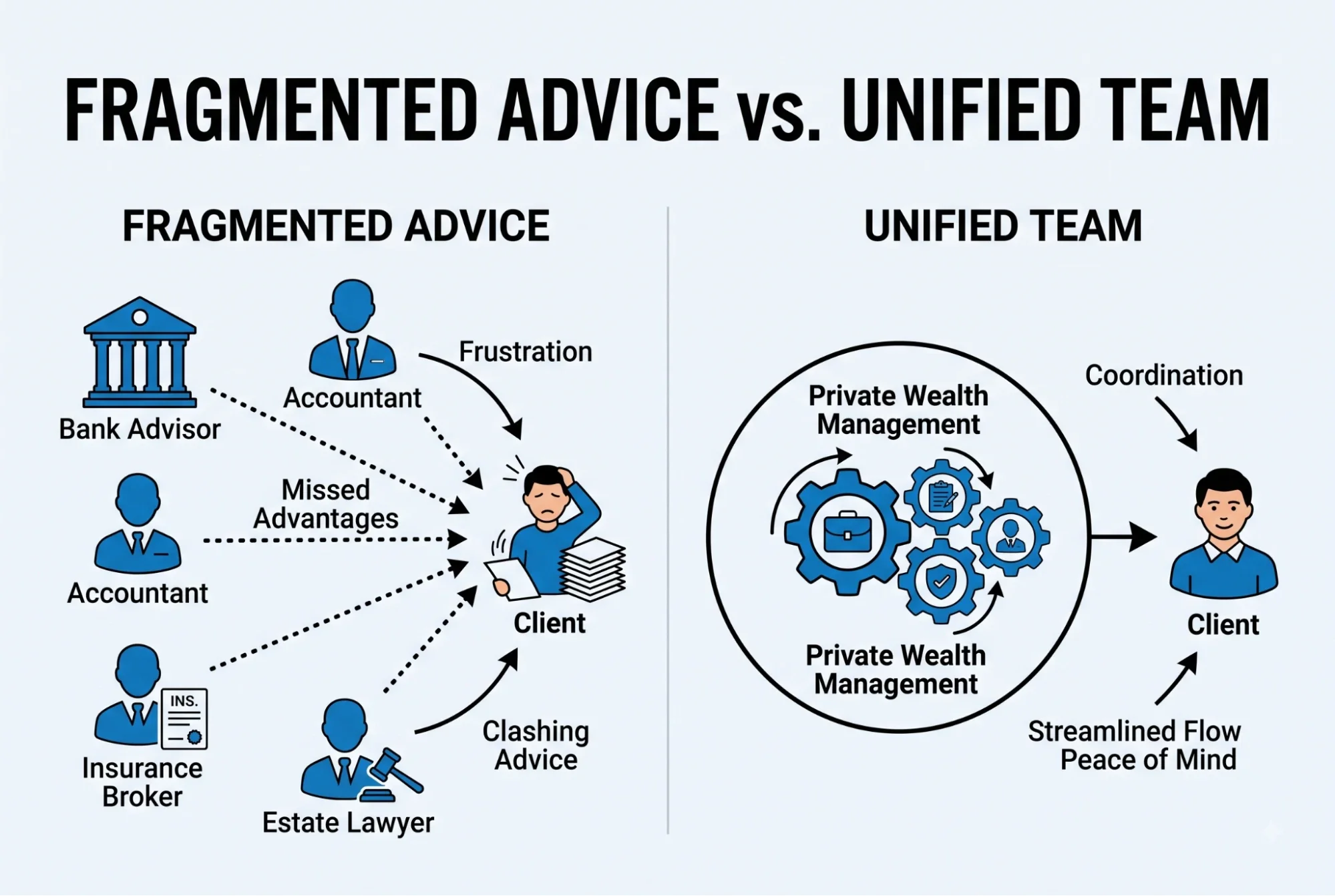
Image Source: Gemini 2026
The Whole-Person Approach
Private wealth management should give equal weight to your financial growth and your personal well-being, because a strategy that grows significant wealth while adding stress to your client's life is not a complete strategy. A genuine holistic approach treats your financial goals and your priorities as equally important.
Private Wealth Management Toronto: How the Landscape Really Breaks Down
Comparing wealth management firms in Toronto usually involves three options: big banks, boutique investment shops, and multi-family offices, each with a different tradeoff between scale, attention, and coordination.
The Big Bank Experience
Big banks offer scale and brokerage services, but incorporated business owners and C-suite executives often feel like small fish in a big pond. Client relationships get handed off every 18 months to a new advisor who has to relearn your business history from scratch. Advice tends to be generalized rather than built around your specific tax situation, business structure, or liquidity events.
The Boutique Investment Shop
Boutique firms can offer more attention, but many are narrowly focused on portfolio management rather than the full range of financial planning. You still end up managing the coordination yourself, just with a smaller, more personal version of the same silo problem.
Trust Is the Real Barrier to Switching
Trust is often the biggest barrier standing between a client and a better wealth management relationship. Many high-net-worth individuals stay with an underperforming advisor simply because starting over feels disruptive, even when the fit is wrong.
Earning real trust takes patience, yet it begins with clear openness. A private wealth management firm should walk you through its advice in plain terms, be upfront about how it gets paid, and show a sincere focus on your unique situation, not a generic, cookie-cutter sales pitch.
When clients are listened to and respected, they’re much more likely to remain for years, which is exactly the result a well-coordinated relationship approach is designed to achieve.
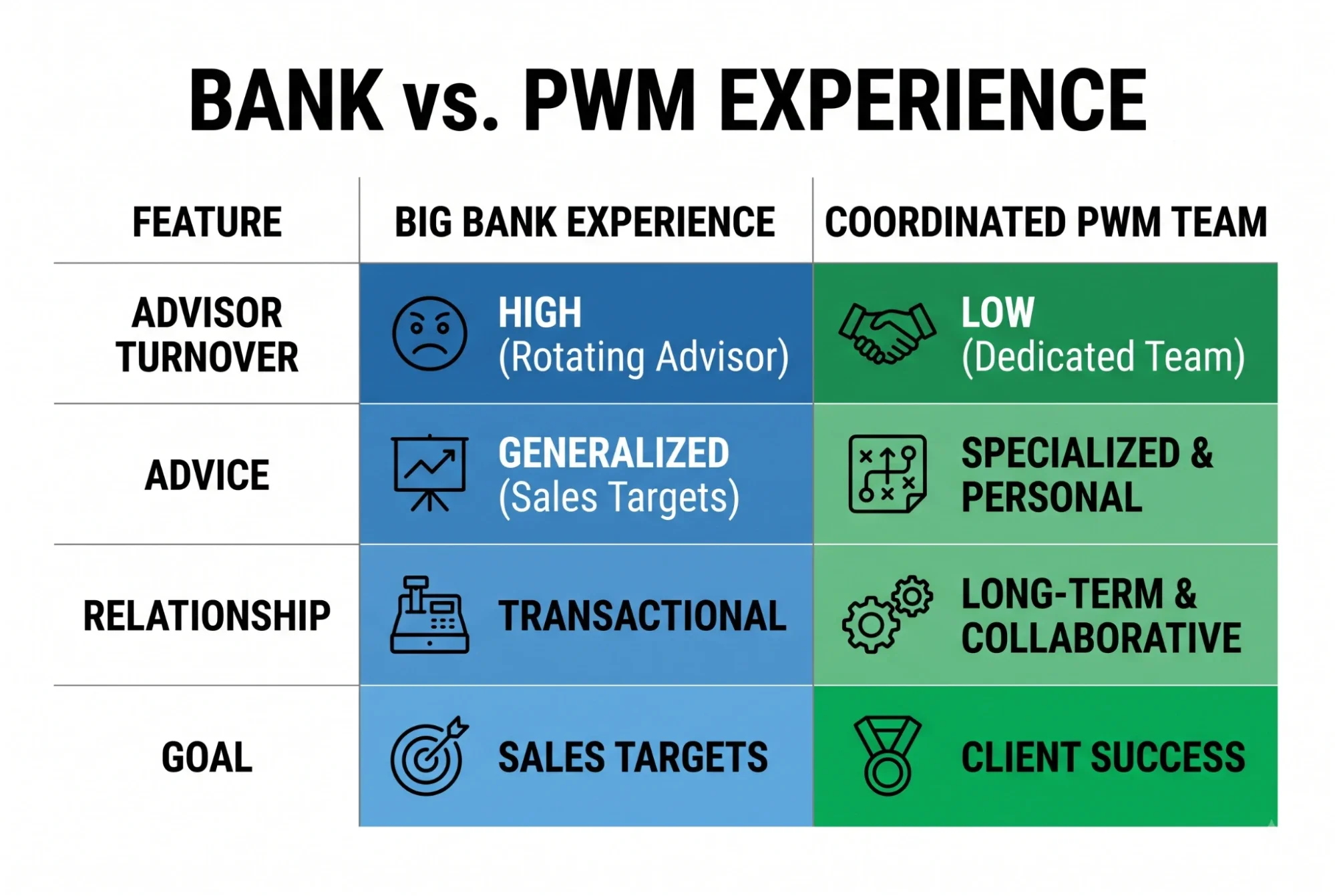
Image Source: Gemini 2026
What Client Retention Data Shows
Industry research supports the view that relationship‑oriented service drives higher client satisfaction: the J.D. Power 2024 Canada Full‑Service Investor Satisfaction Study found that more than half of advised clients still experience a purely transactional relationship with their firm, rather than getting real ongoing advice, and that group trusts their advisor less and sticks around less. Clients who had an actual written financial plan trusted their advisor far more than those who didn’t.
That trend points to something worth noticing. Clients increasingly want a team that stays with them, not one that rotates every couple of years. The firms that build lasting client relationships tend to be structured for continued success rather than short-term sales targets.
The Multi-Family Office Alternative
Multi-family offices can address the coordination challenge, but they usually require a net worth far higher than that accumulated by most successful business owners and senior executives. That creates a clear gap for professionals who want multi-family office-level support without an eight-figure minimum.
This is the gap that a properly structured private wealth management firm is designed to fill. You get the coordinated, whole-person model of a multi-family office, delivered at a fraction of the traditional cost, matched to your specific goals, life stage, and complexity.
Tax Planning Toronto: What High-Net-Worth Individuals Need
HNW individuals in Toronto need tax planning that treats their income structure, whether corporate retained earnings or executive compensation, as one coordinated strategy, not a once-a-year filing exercise.
Corporate Structure and Retained Earnings
For incorporated business owners and professionals such as doctors, lawyers, dentists, and accountants, that coordinated strategy starts with corporate structure: how much of your income you actually keep depends on how your corporation, personal finances, and investment strategy interact, not on any one piece in isolation.
Tax efficiency becomes an ongoing focus rather than a once-a-year exercise, and key person insurance is another piece worth factoring into that corporate structure, since it protects the business itself if a critical owner or executive is suddenly unable to work.
Cash Flow, Executive Compensation, and Liquidity Events
For executives, that same coordination problem shows up on the compensation side: senior executives and repeat tech founders face a unique set of tax-planning issues, often tied to equity compensation, annual bonuses, or major liquidity events such as selling a company.
These moments require a tax strategy that protects cash flow and is planned well in advance, rather than reacting after the fact.
Where Insurance Fits Into Tax Strategy
That same coordination reaches into insurance too: it's often the most underused piece of a tax strategy, particularly for incorporated professionals managing corporate retained earnings. A coordinated wealth strategy weighs insurance alongside investment and estate planning, not as an isolated purchase decision.
Investment Management Toronto: What a Coordinated Structure Looks Like
A coordinated investment structure pairs discretionary, licensed portfolio management with direct access to the people managing your money, all working within a regulated framework that adapts to your life stage and complexity.
Discretionary, Licensed Portfolio Management
Look for investment management firms in Toronto that work through licensed portfolio management partners. This structure allows your advisor to focus on your overall wealth planning while investment specialists handle the discretionary decisions within the parameters you have agreed on, drawing on a broad range of investment strategies and, where appropriate, alternative asset classes such as private equity.
Working Within a Regulated Framework
Licensed investment partners working in Canada are generally registered with the Canadian Investment Regulatory Organization (CIRO), and qualifying client accounts are often covered by the Canadian Investor Protection Fund. This oversight is important because it provides a clear layer of protection and accountability that unregulated options simply lack.
This level of oversight also strengthens the trust that supports any long-term advisor relationship. Clients should feel comfortable asking how their portfolio is built, how fees are calculated, and what options exist if something goes wrong, and a regulated firm should respond clearly, without hesitation.
Direct Access, Not Just Online Access
Financially sophisticated clients don’t want to be educated on the basics. They want direct access to the people managing their portfolio, not just online access to a dashboard.
A coordinated firm should give you both: real-time visibility into your investments and a relationship with an advisor who can speak to your strategy whenever priorities shift.
Aligning Investments With Life Stage and Complexity
Your investing plan should match where you are in life, whether you’re an accomplished business owner protecting retained earnings, a C-suite executive growing family wealth, or a repeat tech founder navigating a recent liquidity event.
Retirement planning and the income you will need in retirement change as your life and business evolve. Pairing you with the right advisor for that complexity is what sets coordinated wealth management apart from basic portfolio management.
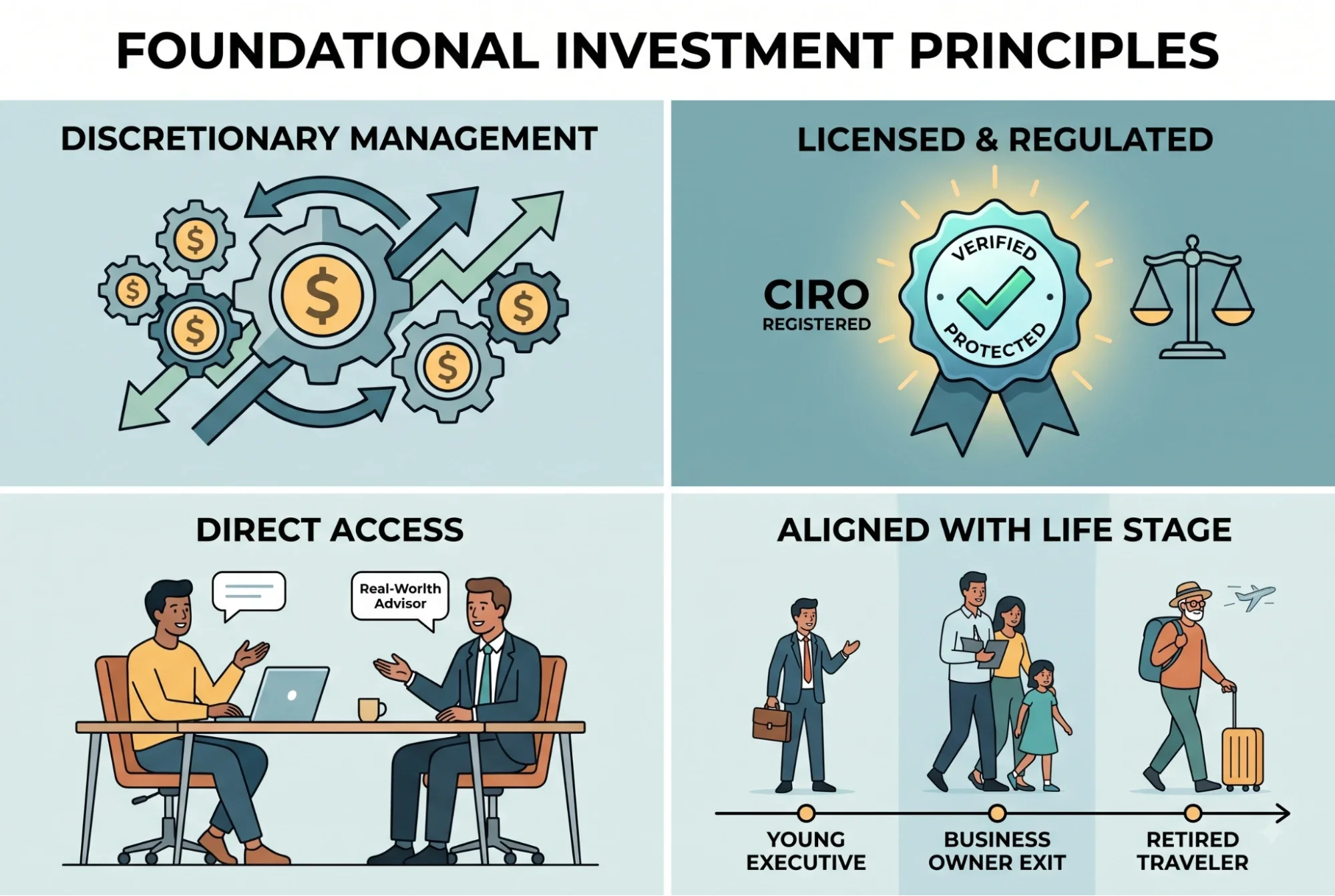
Image Source: Gemini 2026
Estate Planning and Intergenerational Wealth Transfer
Private wealth management extends into your estate plan: aligning tax, insurance, and charitable giving decisions with how you want wealth passed to the next generation, rather than treating each as a separate legal or financial exercise.
Coordinating Estate Strategy With Tax and Insurance
Estate planning strategies in Canada work best when they’re built alongside your tax and insurance plans rather than as a separate legal exercise. A holistic wealth strategy, supported by trust services where needed, ensures your estate plan reflects the same coordinated thinking as the rest of your finances.
Charitable Giving and Legacy Planning
Charitable giving is often part of a broader estate and legacy strategy for clients who have built significant wealth over their careers. A perfect example of this coordination is structuring charitable giving alongside tax planning, so that philanthropic goals and tax efficiency work together rather than as separate decisions.
FAQs About Private Wealth Management
-
Private wealth management coordinates portfolio management, tax planning, insurance, and estate planning under one team, so decisions in one area support your goals in every other area of your financial life.
-
Requirements vary by firm. Some multi-family offices set very high minimums, while other private wealth management firms in Toronto offer coordinated service starting around $500,000 in net worth.
-
For clients with complex tax, business, or estate needs, coordinated wealth management often creates value well beyond its cost by avoiding missed opportunities across tax planning, insurance, and investment strategy.
-
Yes. Tax planning is a core component, particularly for incorporated professionals and business owners managing retained earnings, executive compensation, or liquidity events.
Key Takeaways
Private wealth management coordinates tax planning, portfolio management, and estate planning under one team, rather than through separate, disconnected advisors.
High-net-worth clients in Toronto can access multi-family office-level wealth management without the typical eight-figure minimum.
Licensed portfolio management partners provide clients with direct access, regulatory protection, and discretionary investment management tailored to their goals.
Coordinated wealth planning helps incorporated professionals and business owners align tax efficiency with estate planning and insurance strategy.
Ready for a Coordinated Wealth Strategy?
Comparing wealth management firms in Toronto often comes down to one question: Do you want another advisor, or a coordinated team that finally talks to each other?
Private wealth management, at its best, gives you the clarity of a single wealth strategy across investing, tax planning, insurance, and estate planning, delivered by an advisor and team who sit next to you rather than across from you, and who are focused on your continued success, not a transaction.
If you’re ready to move from siloed advice to a strategy built around your full financial life, book a no-obligation discovery call to see what a coordinated wealth strategy with Longevity Wealth could look like for you.