

Image Source: Canva
Estate planning in Canada is about deciding who gets your assets, who makes choices if you can’t, and how much tax your estate pays first. A deliberate plan brings your wills, trusts, and tax strategy together to protect wealth for the next generation.
Nobody plans their estate by accident. The families who transfer wealth smoothly to the next generation built that plan for years, sometimes decades, before anyone needed it. That’s what estate planning in Canada is designed to do.
A straightforward will rarely addresses the issues for affluent families, retirees, and owners of incorporated businesses. Corporate shares, multiple properties, blended families: one question covers it all. What happens to everything you’ve built once you’re no longer the one managing it?
That’s what this guide is for. At Longevity Wealth, we’ll walk you through the documents and strategies behind solid estate planning in Canada, so more of what you’ve built reaches the people and causes you care about.
What is Estate Planning in Canada?
At its core, estate planning in Canada means getting your legal, financial, and tax affairs in order so your assets pass on in the way you intend, without unnecessary delay, taxes, or tax leakage.
It’s more than a will. A full plan also covers who makes decisions for you if you’re incapacitated, how your corporation and investments are structured, and how much tax comes off the top when you pass away.
Think of it as the last stage of wealth management, not an afterthought. Everything earlier in a financial plan is about growing and protecting your money while you’re here. Estate planning ensures it still does what you wanted after you’re gone.
Who Needs an Estate Plan?
Technically, anyone with assets or family members benefits from having one. But planning gets a lot more complicated, and a lot more valuable, for:
Incorporated business owners with retained earnings and business interests within a corporation
C-suite executives with concentrated stock, deferred compensation or executive benefits
Serial entrepreneurs with many business entities, foreign assets, and liquidity events
Retirees juggling registered accounts, real estate, and a desire to leave a legacy
Blended families navigating family dynamics, where beneficiary intentions need to be spelled out clearly. If that sounds like you, a free online will template isn’t going to cut it.

Image source: Canva
The Core Documents Every Estate Plan Needs
Every complete estate plan rests on four documents: a will, a power of attorney for property, a power of attorney for personal care, and, in many cases, a trust. Skip one, and you’re leaving a gap that provincial default rules, not your family, will end up filling.
A Will
Your will names your executor, spells out how your assets are distributed, and, if you have young kids, names a guardian. Pass away without one, and your estate gets divided up according to provincial intestacy rules, which almost never match what someone would have actually chosen for themselves.
Powers of Attorney
There are two types of power of attorney that matter here: one for property, which lets someone manage your finances and company interests if you’re unable to do so; and one for personal care, which lets someone make decisions about your health and your living arrangements.
Both are worth having in place before you need them. Losing capacity is as real a risk as death, and just as worth planning for.
Trusts
A trust splits legal ownership of specific assets from who actually benefits from them. Families use them to control when an inheritance is paid out, shield assets from a beneficiary’s creditors or a divorce, and sometimes manage tax exposure along the way. They’re especially handy if your beneficiaries are young or simply not ready to manage a large inheritance on their own.
What Happens to Your Estate When You Die in Canada
When you die in Canada, your estate incurs two costs before your beneficiaries see a cent: capital gains tax on a deemed disposition and probate fees in most provinces.
Canada has no inheritance tax, but these two elements determine what your estate actually pays before anyone inherits anything.
Deemed Disposition and Capital Gains at Death
Under the Income Tax Act, you’re deemed to have sold everything you own at fair market value the moment before you die, even if nothing really changes hands. That is considered disposition, and it can create a genuine capital gains bill on investments, real estate beyond your primary residence and corporate shares, says the Canada Revenue Agency.
There are a few outs. Property left to a surviving spouse or common law partner can qualify for a tax-deferred rollover, pushing the capital gain down the road until the spouse eventually sells.
Qualified small business corporation shares may also tap the lifetime capital gains exemption, which can shelter a good chunk of a business sale or transfer from tax liability entirely, something that matters a lot if you’re an incorporated business owner thinking about your eventual exit.
Probate Fees Across Canada
Provincial probate fees vary, and sometimes a will must go through probate before anything can happen. Ontario's Estate Administration Tax is 1.5% on the estate value above $50,000. It looks different elsewhere:
British Columbia uses a graded scale
Alberta uses flat rates based on brackets
Quebec uses set filing fees rather than a percentage.
Joint ownership, designated beneficiaries on registered accounts, insurance and some trust structures can all reduce the portion of an estate that goes through probate. They each have their own tradeoffs around control, tax and legal fees, and that’s the kind of thing you’ll want to run by an estate planner before you commit to one.
Wealth Transfer Strategies for Business Owners and Affluent Families
Business owners often use two strategies: an estate freeze to lock in today’s value, and trusts or insurance to transfer it efficiently. The right fit depends on the family's timeline, the number of shareholders, and how much liquidity the estate will need at death.
Estate Freeze
An estate freeze works by having a business owner swap their common shares, the ones that carry future growth, for fixed-value preferred shares, then issue new common shares to a family member, family trust, or holding company. The value of the business gets locked in on the original owner’s shares, while all future growth flows to the next generation instead.
Business owners typically use the estate freeze Canada tax rules, making it possible to
cap their tax exposure at today’s value,
hand future appreciation to the next generation ahead of schedule, and
build in flexibility for income splitting or succession planning later on.
It’s a technical move, and it takes an estate planner, an accountant, and a corporate lawyer working together to get the structure right under current tax rules and the family’s actual goals.
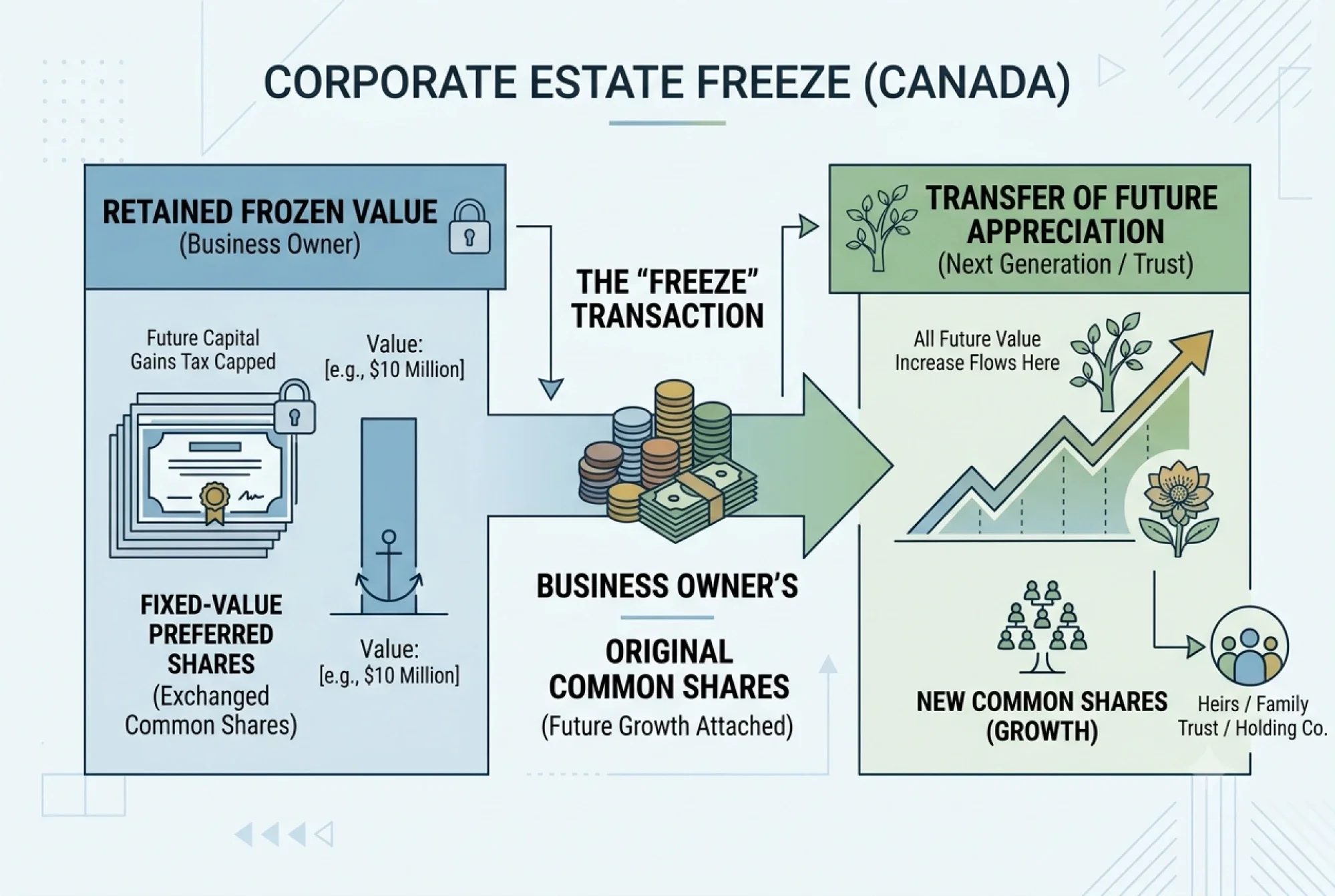
Image Source: Gemini 2026
Trusts and Insurance as Wealth Transfer Tools
Family trusts, corporate-owned life insurance policies, and charitable giving structures each do their own job inside a broader wealth transfer plan. Corporate life insurance, for instance, lets a corporation turn taxable surplus into a tax-free payout through the capital dividend account, often used to cover a tax bill at death or even out an inheritance among kids who aren’t equally involved in the family business.
None of these work particularly well on their own. A trust without a coordinated tax strategy, or an estate freeze paired with an outdated will, tends to create more problems than it solves.
Common Estate Planning Mistakes to Avoid
Most estate planning mistakes come down to outdated documents, mismatched beneficiaries, and putting the plan off too long. Even sharp, financially successful people slip up here, usually because estate planning gets filed under “someday.”
Neglecting a decade-old will, despite major events like a business sale, divorce, or the arrival of a new grandchild. Courts follow what the will actually says. Update it after major events, and revisit every three to five years regardless.
Disregarding mismatches between beneficiary designations and the will. A designation on a life insurance policy or Registered Retirement Savings Plan (RRSP) usually overrides the will, so an outdated one can send money somewhere you never intended. Check both together whenever either changes.
Assuming corporate shares transfer as easily as personal assets do. They don't. Shareholder agreements, valuation clauses, and deemed disposition rules trigger the moment shares change hands. Get the shareholder agreement and will aligned before either is finalized.
Treating powers of attorney like paperwork instead of core planning documents. Without one, incapacity, not just death, can leave nobody with legal authority to run the business, pushing the family into a public guardianship application. Draft both alongside the will.
Reaching for a generic online template when the estate has corporate, cross-border, or blended-family complexity. Templates assume one jurisdiction, one family, no company. Bring in an estate planner and lawyer instead.
These mistakes stem from a plan that was built once and never revisited, not from a lack of planning. Coordinating a will, powers of attorney, shareholder agreements, and tax strategy takes a professional who can see all the pieces at once, which is exactly where an estate planner earns their fee.
Why You Need an Estate Planner in Toronto
An estate planner in Toronto coordinates the legal, tax, and insurance components of your plan so they work together rather than pulling in different directions. That coordination is what separates estate planning Toronto families can rely on from a plan that just looks good on paper.
At Longevity Wealth, that coordination is built into how we work: your advisor sits alongside your legal and tax professionals, rather than handing you off between them.
FAQs About Estate Planning in Canada
-
Start by listing out your current assets, debts, and intentions, then get a valid will and powers of attorney in place. From there, an estate planner can help layer in trusts, insurance, and tax strategies that fit your specific situation.
-
No. Canada doesn’t charge a direct inheritance tax. What your estate may owe instead is capital gains tax through deemed disposition at death, plus probate fees in most provinces.
-
It locks in the current value of a business owner’s shares for tax purposes while future growth shifts to the next generation or a family trust, usually as part of planning a business succession or trimming future tax exposure.
-
Every three to five years is a reasonable rhythm, and any time a major life event hits: a business sale, marriage, divorce, or a new grandchild.
Key Takeaways
Estate planning in Canada covers your will, powers of attorney, trusts, and tax strategy, not just who gets what.
Deemed disposition treats your capital property as sold at death, which can trigger a real capital gains bill without proper planning.
Probate fees vary by province. Ontario charges 1.5% on estate value above 50,000 dollars.
An estate freeze locks in a business owner’s share value today while future growth shifts to the next generation.
Coordinated wealth transfer strategies, spanning trusts, insurance, and tax planning, protect more of an estate than any one tool used alone.
Live Well, Longer, With a Legacy Built on Purpose
A well-built estate plan turns what you’ve built into a legacy your family can rely on.
Good estate planning isn’t really about the ending. It’s about making sure your business, your investments, and your family’s future keep going exactly the way you intended.
At Longevity Wealth, we bring estate strategy together with tax planning, insurance, and investment management under one coordinated advisory model, delivered by a dedicated advisor matched to your private wealth goals. Not legal or tax advice, but the difference between owning legal documents and having an actual plan.
Estate planning in Canada starts with one conversation, not months of paperwork. See where your estate plan stands today, and book a no-obligation discovery call. No pressure today.
