Corporate-Owned Life Insurance: How It Works

Image Source: Gemini 2026
Corporate-owned life insurance allows a corporation to buy a policy on a shareholder or key employee, paying premiums with corporate dollars while the cash value grows tax-deferred. At death, proceeds flow through the capital dividend account as a tax-free payout to shareholders.
For incorporated business owners, cash sitting inside a corporation is a good problem to have and a genuinely tricky one to solve.
Retained earnings that aren’t reinvested in the business are often taxed heavily if left to accumulate or paid out as dividends. Corporate-owned life insurance, or COLI, is one of the few strategies that can shelter that surplus, grow it tax-efficiently, and eventually transfer wealth to the next generation with minimal tax drag.
This isn’t a retail insurance product bought off a rate table. It’s a planning tool that sits at the intersection of tax strategy, estate planning, and investing, which is exactly why it belongs in a broader wealth strategy rather than a standalone policy purchase.
Below, we at Longevity Wealth break down what corporate-owned life insurance is, how it works, and when it makes sense for incorporated professionals and business owners in Canada.
What Is Corporate-Owned Life Insurance?
Corporate-owned life insurance is a life insurance policy purchased and owned by a corporation, rather than by an individual, on the life of a shareholder, key employee, or other person connected to the business. The corporation pays the insurance premiums, owns the policy, and is typically named as beneficiary.
Because the corporation owns the policy, it can fund it with corporate dollars taxed at the lower small-business rate, rather than first funding it with personal dollars taxed at a much higher personal rate.
This is one of the core reasons company-owned life insurance appeals to incorporated professionals. It lets surplus corporate cash work harder than it would if it were sitting in a taxable corporate investment account.
How COLI Differs From Personal Life Insurance
Corporate-owned life insurance differs from personal coverage in both respects: it's funded with corporate dollars, and the death benefit is paid to the corporation, not a named individual, then to shareholders through mechanisms designed to minimize additional tax.
Personally owned life insurance is funded with after-tax personal dollars and pays a death benefit to a named individual or estate. Corporate-owned life insurance strategies in Canada work differently on both ends.
The distinction matters because it changes who benefits, how the payout is taxed, and how the strategy fits into a shareholder's overall estate plan.
Term Versus Permanent Life Insurance for COLI
Most corporate life insurance strategies use permanent life insurance rather than term insurance. Term life insurance offers lower premiums but expires after a set period and builds no cash value, which makes it poorly suited to a long-term wealth strategy.
Permanent policies, by contrast, are designed to remain in force for life and to build cash value over time. For a Canadian-controlled private corporation looking to shelter surplus earnings over the long term, that cash value is the whole point.
How Corporate Life Insurance Works, Step by Step
Corporate life insurance works in five steps, from the corporation purchasing the policy through the tax-free payout to shareholders via the capital dividend account.
Understanding the mechanics helps clarify why this strategy is attractive to business owners with retained earnings, and why it requires careful structuring with an advisor rather than a do-it-yourself approach.
1. The Corporation Purchases the Policy
The company applies for and owns a permanent life insurance policy, usually whole life or universal life, on a shareholder or key person. As a Canadian-controlled private corporation, the business can generally structure this ownership to access the tax advantages built into the strategy.
2. Insurance Premiums Are Paid With Corporate Dollars
Because premiums are paid from the corporation rather than the shareholder's personal bank account, the strategy takes advantage of the corporate tax rate, including any benefit from the small business deduction on active business income.
It's worth noting up front that these insurance premiums are generally not tax-deductible as a business expense. The tax benefits of COLI come later, through how the death benefit is distributed, not through a premium write-off today.
3. Cash Value Grows Inside the Policy
Permanent life insurance policies build cash value over time, and this growth is not taxed the way interest or dividends in a corporate investment account would be. Some policies also permit policy loans against the cash value, providing the business with liquidity if it needs cash flow during a downturn or to fund short-term obligations.
This tax-deferred growth is one of the main reasons incorporated business owners use their own life insurance as a wealth-accumulation tool alongside their other investments, not only for protection.
4. The Death Benefit Is Paid to the Corporation
When the insured person passes away, the life insurance death benefit is paid directly to the corporation as the beneficiary. Most of that amount can typically be credited to the corporation's capital dividend account, or CDA.
The exact CDA credit equals the death benefit minus the policy's adjusted cost basis, a figure closely tied to the net cost of pure insurance. An insurance advisor and a tax advisor can work together to confirm this figure at the time of a claim.
5. The CDA Allows a Tax-Free Payout to Shareholders
The capital dividend account allows a corporation to pay out certain amounts to Canadian resident shareholders completely tax-free, provided the proper election is filed under the Income Tax Act.
For corporate-owned life insurance, this means a significant portion of the death benefit can reach shareholders, or their estate, as a tax-free capital dividend, without triggering personal income tax on that payout.
This last step is where corporate life insurance shows its real value. It’s a tool that funds itself with lower-taxed corporate dollars, grows on a tax-deferred basis, and ultimately transfers wealth to the next generation in one of the most tax-efficient ways available under Canadian tax law.
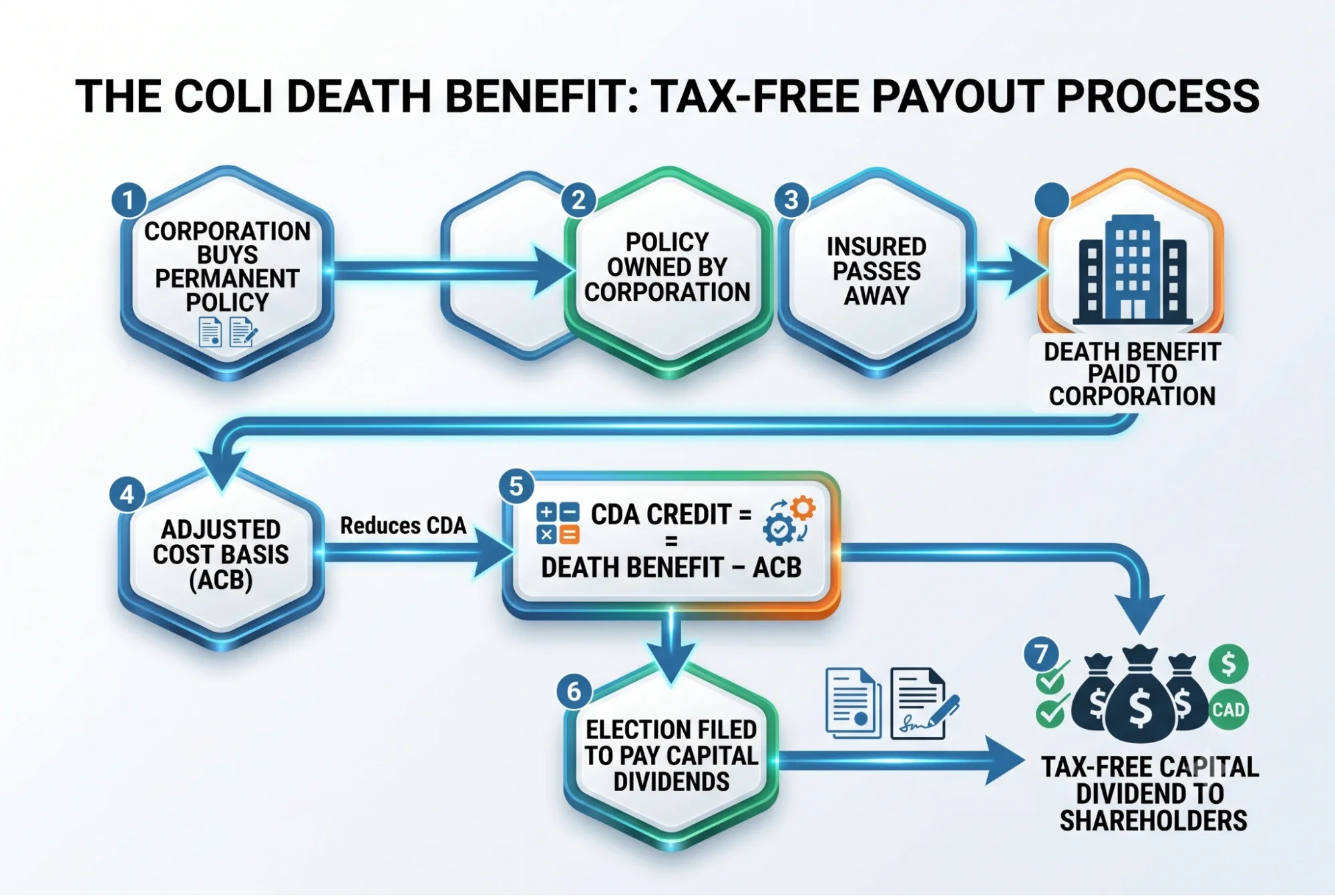
Image Source: Gemini 2026
Why Incorporated Business Owners Use COLI
Corporate-owned life insurance is not right for every incorporated professional, but for the right profile, it solves a very specific and common problem: what to do with surplus retained earnings that are not needed in the business.
Sheltering Excess Corporate Cash
Doctors, dentists, lawyers, and other incorporated professionals frequently accumulate retained earnings beyond what the business needs to operate. Rather than leaving that cash exposed to corporate investment taxation, COLI insurance allows a portion of it to grow inside a life insurance policy with more favourable tax treatment.
Funding Buy-Sell Agreements and Business Succession
For businesses with multiple shareholders, corporate-owned life insurance is also a common way to fund buy-sell agreements. If a shareholder passes away, the death benefit can provide the estate liquidity needed for the remaining owners to buy out that shareholder's interest without straining the company's operating cash.
This makes COLI a dual-purpose tool. It supports long-term tax planning while also protecting business continuity if a key employee or owner is unavailable.
An Asset on the Balance Sheet
Because permanent policies build cash surrender value over time, a well-structured COLI policy can appear as a genuine asset on the corporation's balance sheet, not just a recurring expense.
That combination of tax efficiency and asset value is part of what makes the strategy attractive to incorporated professionals thinking beyond this year's tax return.
Complementing, Not Replacing, Key Person Insurance
It's worth noting where COLI ends and key person insurance begins, since the two are often confused. Key person insurance protects the business against the financial disruption caused by the loss of a critical employee or owner, essentially functioning as an employee benefit tied to that individual's role. Key person coverage on your most valuable people is about protecting the business itself.
Corporate-owned life insurance is a broader wealth and estate strategy that uses the same type of underlying life insurance policy. Many incorporated owners benefit from both, structured to work together rather than overlap.
If you're exploring how to protect your business against the loss of a key employee, our companion piece on key person insurance walks through that aspect of the strategy in detail.
What to Consider Before Setting Up a COLI Strategy
Before setting up a COLI strategy, coordinate three things: your broader tax and estate plan, your corporate/shareholder structure, and the right policy type and amount.
Coordination With Your Broader Tax and Estate Plan
Because COLI touches corporate tax rules, the capital dividend account, and estate planning simultaneously, it should never be set up in isolation. Your insurance and tax advisors need to work from the same picture of your goals, your corporate structure, and your family's long-term plans.
Corporate Structure and Shareholder Agreements
Multiple shareholders, holding companies, and buy-sell agreements can all affect how a corporate life insurance policy should be structured. Getting this wrong can create unintended tax consequences or disputes among shareholders down the line.
The Right Policy Type and Amount
Not every exempt life insurance policy is designed the same way, and the amount of coverage should reflect both the corporation's surplus cash position and the shareholders' long-term goals.
This is a case where more coverage is not automatically better. The strategy should be sized to the actual planning objective, not the maximum the corporation can afford.

Image Source: Gemini 2026
FAQs About Company-Owned Life Insurance
-
COLI stands for corporate-owned life insurance, a policy purchased and owned by a corporation on a shareholder or key employee, rather than by an individual.
-
The corporation pays premiums and owns the policy. At death, the death benefit goes to the corporation, and most of it can pass to shareholders tax-free through the capital dividend account.
-
COLI is a wealth and estate strategy using corporate cash. Key person insurance protects the business from the financial impact of losing a critical employee. Many businesses use both together.
-
The corporation is typically the beneficiary. It then distributes eligible amounts tax-free to Canadian resident shareholders through the capital dividend account.
Key Takeaways
Corporate-owned life insurance allows a Canadian-controlled private corporation to fund a policy with corporate dollars rather than higher-taxed personal income.
Cash value inside permanent life insurance grows tax-deferred, unlike a corporate investment account.
The capital dividend account lets the corporation pass most of the death benefit to shareholders as a tax-free capital dividend.
COLI can also fund buy-sell agreements, giving multiple shareholders estate liquidity if an owner passes away.
Insurance premiums are generally not tax-deductible, so the strategy's tax benefits come from the payout structure rather than a write-off.
COLI works best when structured alongside a broader tax, estate, and investment plan, not as a standalone purchase.
A Strategic Tool, Not a Standalone Product
Corporate-owned life insurance is one of the most effective ways for incorporated business owners in Canada to shelter surplus cash, grow it tax-efficiently, and transfer wealth to the next generation. But it only works as well as the plan behind it.
At Longevity Wealth, corporate life insurance is never treated as an isolated purchase. It's coordinated with your tax strategy, investment approach, and estate plan under one roof, so every piece works together rather than in silos. If you're an incorporated professional or business owner wondering whether COLI insurance belongs in your wealth strategy, a discovery call with our team is the place to start.
Book a no-obligation consultation with Longevity Wealth to explore whether corporate-owned life insurance fits your goals.