

Corporate tax planning for incorporated professionals is the year-round work of deciding how your corporation pays you, invests retained earnings, and protects the small business deduction. It works best when tax, investment, insurance, and estate advice are integrated into a single strategy.
Your accountant files your corporate tax return every year. That keeps you compliant, but it isn't the same as planning. Corporate tax planning looks at how you pay yourself, how your investments grow inside the company, and what your practice will fund in retirement.
For most incorporated doctors, lawyers and dentists, those decisions come from different offices. Your accountant has the return, your insurance broker has the policy, and your bank planner mostly focuses on your registered retirement savings plan (RRSP). That usually leaves you connecting the dots after a full day with patients or clients.
At Longevity Wealth, we bring those pieces into one plan.
What Is Corporate Tax Planning for Incorporated Professionals?
Corporate tax planning means deciding in advance how your professional corporation earns income, pays you, and invests the remainder. The goal is simple. Your household pays less total tax over your lifetime, and more net income stays with your family.
A professional corporation is a company that doctors, dentists, lawyers, and other licensed professionals set up with approval from their governing body. Most qualify as a Canadian-controlled private corporation (CCPC) under the Income Tax Act. That status is what gives them a lower tax rate on active business income.

Image Source: Canva
How Is a Professional Corporation Taxed in Canada?
A professional corporation pays a reduced tax rate on its first $500,000 of active business income through the small business deduction. Anything above that limit is taxed at the higher general corporate income tax rate.
Take Ontario. The combined small business rate is 12.2%, which is the 9% federal rate plus Ontario's lower provincial rate of 3.2%. So on $100,000 of active business income, you'd pay about $12,200 in corporate tax. Income above the limit is taxed at a combined 26.5%. Rates shift from province to province, and our ranking shows what incorporated business owners keep in each one.
Both rates are well below the top personal income tax rate, and that gap is where tax deferral comes from. Income earned within the company is taxed at the corporate rate first, and personal tax applies only after the funds are paid out to you.
Canada's integration rules aim for roughly the same total tax either way, so deferral changes the timing, not the total. In the meantime, your investments grow tax-deferred within the company, and deciding when to take that money out is a big part of Canadian tax planning.
Salary vs. Dividend: How Should You Pay Yourself?
Salary is tax-deductible to your corporation, and it builds RRSP room and a future Canada Pension Plan (CPP) benefit. Dividends are simpler to pay but give you neither. Most professionals end up with a compensation strategy that mixes the two to fit their cash flow and retirement plan.
What Does Paying Yourself a Salary Do?
The salary you’re paid reduces your company's taxable income. It's fully taxable in your hands, like any employee's pay, and it comes with CPP contributions from both you and the company.
In 2026, the maximum base CPP contribution is $4,230.45 each for employees and employers. As a business owner, you pay both shares, which comes to about $8,460 a year before the second additional CPP contributions (CPP2) apply to higher earnings.
In return, lenders like seeing T4 income, and salary counts as earned income if you ever want an individual pension plan.
What Does Paying Yourself Dividends Do?
Dividends come out of after-tax profits. You don't run payroll, and there are no CPP contributions to remit. When you receive dividends, the dividend tax credit on your personal return makes up for part of the corporate tax the company already paid.
Paying taxable dividends can also trigger a refund of the tax the company paid on interest and other investment income, which is tracked as refundable dividend tax on hand (RDTOH).
Why a Salary vs Dividend Calculator Only Tells Part of the Story
A salary vs dividend calculator shows which mix gives you the lowest tax bill this year. It's a useful starting point, but it won't show the RRSP contributions you gave up, or the CPP benefit you'll miss later.
It also can't see a portfolio that's eating into your small business deduction, or a plan to scale back your practice in five years. Your advisor can weigh all of that against your long-term goals.
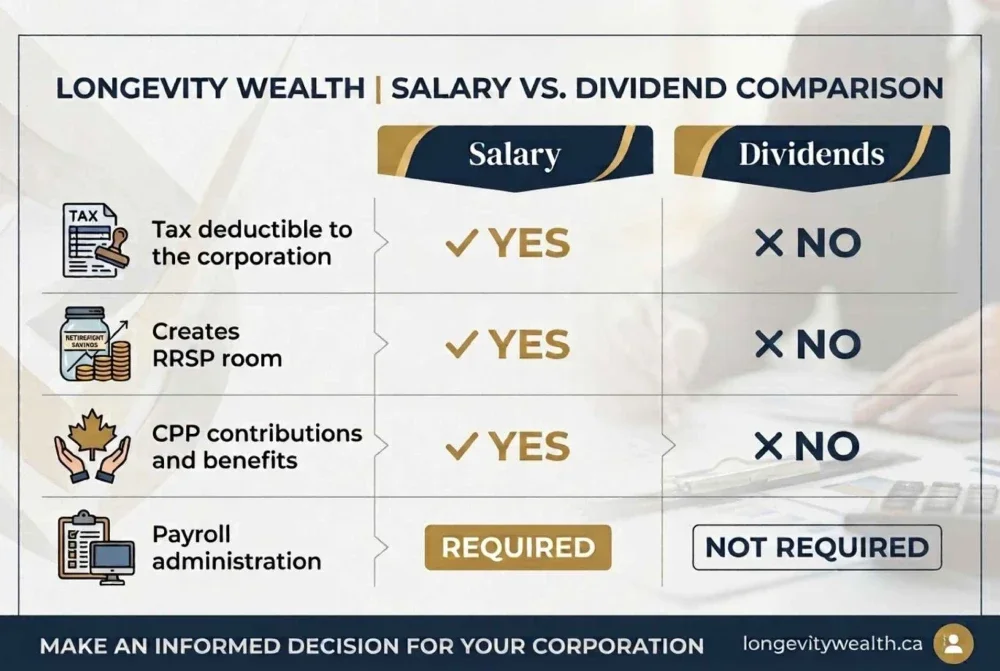
Image Source: Gemini 2026
How Does Passive Income Affect Small Business Deduction?
Once your corporation earns more than $50,000 in passive investment income in a year, its $500,000 small-business limit shrinks the following year. The limit drops by $5 for every $1 over that threshold and disappears completely at $150,000.
Passive investment income includes interest, rental income, portfolio dividends, and the taxable portion of realized capital gains. The CRA looks at the previous taxation year's investment income to reduce the business limit for the current year.
This rule often catches successful professionals off guard. Years of sensible saving inside the corporation can eventually push some of your practice income into the higher tax rate. Interest does the most damage because all of it counts, while only part of a capital gain does.
Tax-efficient Strategies for Passive Income
Three strategies let you continue investing within the corporation while maintaining the limit.
Favour growth over interest. Unrealized capital gains aren't counted until you sell. Investments built for long-term growth keep passive income lower than those built around interest.
Move assets into a pension. An individual pension plan (IPP) holds those assets outside the corporation.
Look at corporate-owned life insurance (COLI). Growth inside an exempt policy that meets the Income Tax Act’s test for tax-sheltered savings usually isn’t counted as passive income.
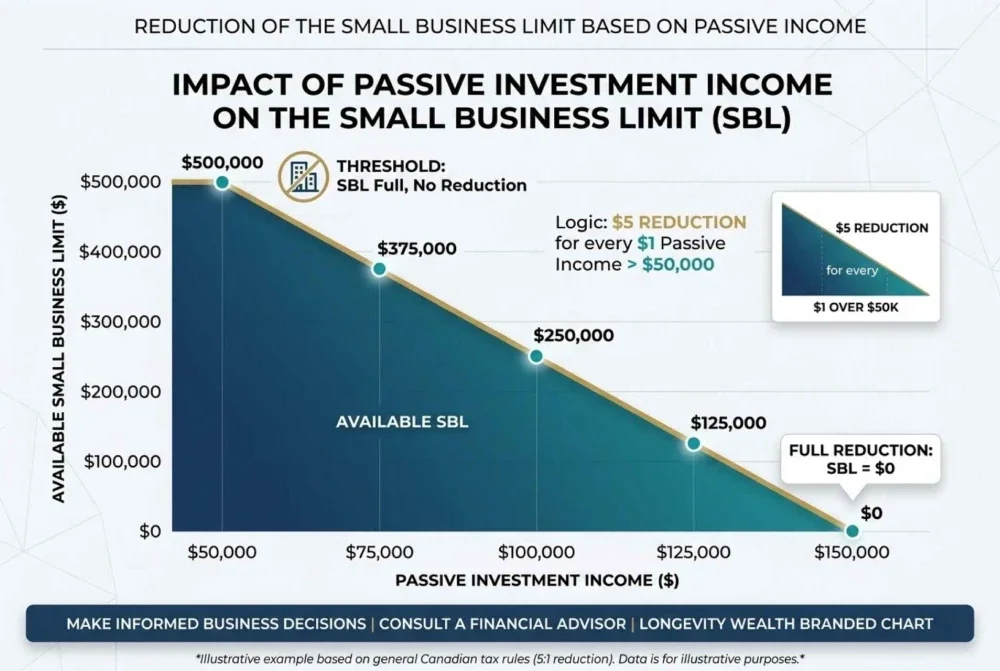
Image Source: Gemini 2026
Can You Split Income With Family Through a Corporation?
Not easily. The tax on split income (TOSI) rules tax most dividends paid to family members at the top personal rate unless an exception applies.
For a professional corporation, the most relevant exception is the excluded business test. It applies when a family member aged 18 or older works in the practice on a regular, continuous, and substantial basis during the current year or any of the five previous years. The CRA considers that test met at an average of at least 20 hours of work a week while the business operates.
The other common exception, the excluded shares test, isn't available to professional corporations, as the CRA's rules on tax on split income confirm.
The rules ease later in life. Once the business owner turns 65, dividends paid to a spouse are generally excluded from TOSI, as long as they would have been excluded in the owner’s hands, which is worth building into your retirement planning. Either way, get tax advice before implementing a share structure. Unwinding one is expensive.
Can You Pay Family Members a Salary Instead?
Yes, as long as the wage is reasonable for the work they actually do. TOSI doesn't apply to employment income, so salary sits outside these rules.
Say your spouse manages the front desk. A fair wage for that role is accepted for tax purposes. Paying for work that isn't done won't stand up to CRA scrutiny.

Image Source: Canva
Which Tax Deductions Can a Professional Corporation Claim?
The main deductions for a professional corporation are everyday business expenses and capital cost allowance (CCA) on equipment such as dental chairs, imaging machines, and computers. A charitable gift made by the corporation is also deductible, while a gift you make personally earns the donation tax credit on your own return.
Capital cost allowance is the yearly deduction the Income Tax Act allows for depreciable property, usually claimed over several years. That may soon change. The federal government proposed a Productivity Mega Deduction in September 2026, which would allow immediate expensing of machinery, equipment and computers acquired on or after September 15, 2026.
If it passes, the timing of your next equipment purchase could significantly impact your tax bill.
What Should You Review Before Your Corporation's Year-End?
Before year-end, review five items: pay, dividends, RRSP contributions, capital gains, and equipment. Your fiscal year-end may not match the calendar year-end, so keep an eye on both.
Salary and bonuses. Set them before year-end so the deductions fall within the correct tax year.
Dividends. They count in the calendar year they're paid, so time each dividend payment around your personal tax plan.
RRSP contributions. Your salary this year sets next year's room. Keep that in mind when you pick the number.
Capital gains. Already sold at a gain this year? Selling investments at a loss can offset it.
Equipment. Depreciable property that's ready for use by year's end can start earning CCA deductions this year.
None of these sit in isolation, so your advisor should integrate your personal and corporate tax planning into one plan.
Corporate Tax Planning Strategies Beyond the Annual Return
The tax-planning strategies with the greatest long-term impact are pension planning, corporate insurance, holding companies, and estate freezes. Our approach to financial planning for business owners puts all four strategies on a single timeline, since each affects your entire plan.
Individual Pension Plan (IPP)
An IPP is a defined benefit pension plan your corporation sets up for you. Company contributions are tax-deductible, and later in your career, they can usually exceed what an RRSP allows. Moving those assets out of the corporation also lowers passive income.
Corporate-Owned Life Insurance (COLI)
With COLI, your company owns and pays for a permanent policy on your life, using funds taxed at the lower corporate rate. When you pass away, much of the death benefit can reach your estate tax-free through the capital dividend account (CDA).
Holding Company
A holding company keeps surplus funds and investments separate from the operating business and can also help with succession planning down the line. Many provinces limit who can own shares in a professional corporation, so check with your governing body and accountant first before setting one up.
Estate Freeze
An estate freeze locks in the current value of your shares and passes future growth to the next generation. It's why many high-net-worth families build a freeze into their tax plan for intergenerational wealth transfer and estate planning in Canada.

Image Source: Canva
Why Tax Planning Services Work Better When Advisors Coordinate
Every corporate tax decision touches your investments, insurance, and estate plan. Integrated tax planning services keep those decisions in one conversation, so every advisor works from the full picture.
A raise creates RRSP room but leaves less to invest inside the corporation. A new corporate policy shifts your passive income and your estate plan at once. Made in separate offices, decisions can quietly undo one another.
At Longevity Wealth, your financial planner works under one roof with insurance specialists, accountants, estate planning experts, and portfolio managers from our partner firms. With this holistic wealth management approach, your professional corporation tax plan is built alongside everything else you own, and financial planning is included at no additional charge. Your advisor sits next to you, not across the desk.

Image Source: Canva
FAQs on Corporate Tax Planning
-
It depends on your cash flow, your retirement plan, and how much you'd rather invest inside the company. Many professionals earn enough to build RRSP room and CPP benefits, then top up with dividends and revisit the split each year.
-
Up to $50,000 a year. Once passive investment income, such as interest, passes that amount, the corporation's $500,000 small business limit starts to shrink the following year, and it's gone entirely at $150,000.
-
You can, but TOSI will likely tax those dividends at the top personal income tax rate unless an exception applies. Two exceptions matter most for professionals: a spouse or adult child who works in the practice an average of at least 20 hours a week, and dividends to a spouse once the business owner turns 65. Minors almost always pay the top rate.
-
Ideally, when you incorporate. Otherwise, start now, since share structures and pay strategies get harder to change the longer you wait.
Key Takeaways
The small business limit covers $500,000 of active business income, and passive income over $50,000 reduces that limit.
Salary builds RRSP room and a CPP benefit. Dividends are simpler but create neither.
TOSI limits income splitting with a spouse or children, so get tax advice before issuing shares.
An individual pension plan or corporate-owned life insurance can ease the passive income limit, and an estate freeze caps the tax your estate owes.
Tax-efficient decisions work best when one team coordinates your investment, insurance, and estate advice.
Build a Tax Plan That Fits Your Whole Life
The point of all this planning is more time for your family and your life outside the practice. A Longevity Wealth advisor can look at your pay mix, tax strategies, investments, and estate structure as one plan, in person in Toronto and Mississauga, or virtually.
See what corporate tax planning could change for your household when you book a no-obligation discovery call with us.
Live well, longer.
